RussiansInUSA editorial team · Facts checked November 11, 2026
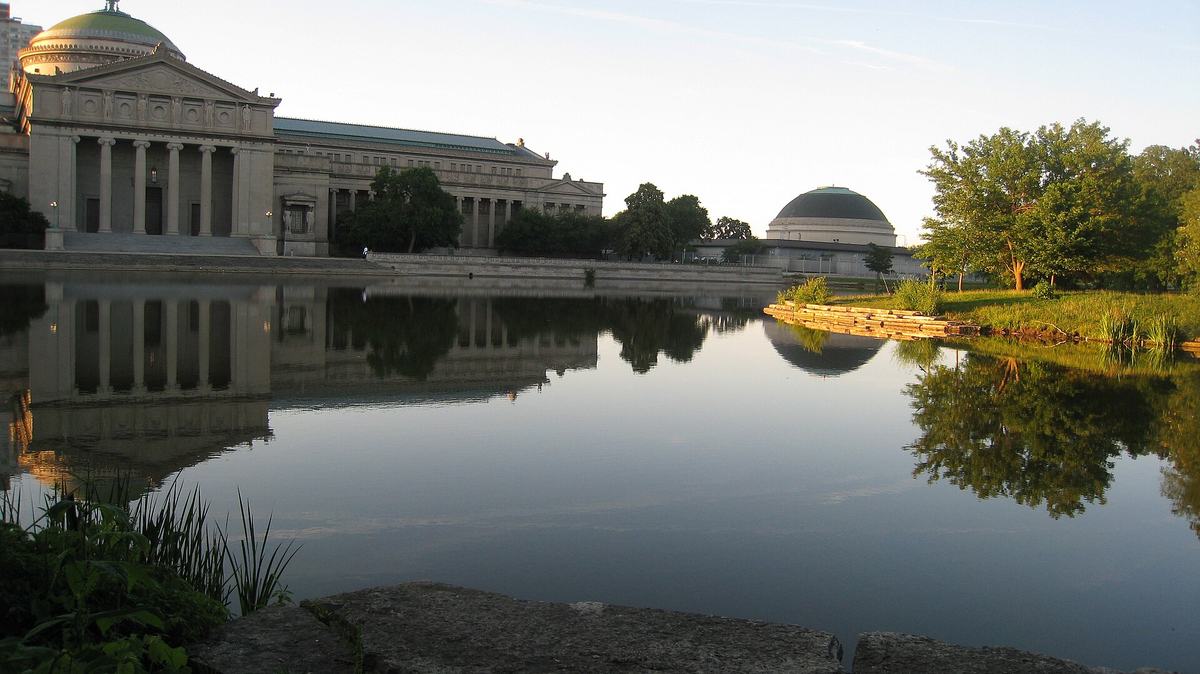
Hyde Park is a neighborhood on Chicago's South Side, on the shore of Lake Michigan. It is home to the University of Chicago, Frank Lloyd Wright's Robie House, the Griffin Museum of Science and Industry, Jackson Park, where the 1893 World's Fair was held, and the new Obama Presidential Center. Walking the neighborhood is free at any hour; you pay only for individual museums. The Chicago city page covers the rest of the city.
Plan on a full day rather than a quick stop. The main sights sit close together, and you can walk from the campus to the science museum and on to the Obama Center.
Hyde Park history: from lakeside resort to university town
According to the Hyde Park Historical Society, Paul Cornell bought 300 acres of lakefront land in 1853 and named it after Hyde Park in London. He gave the Illinois Central Railroad a right-of-way, built a hotel and sold lots to well-off Chicagoans as a resort. Within ten years the village had about 1,000 residents.
The larger Hyde Park Township grew out of it and was annexed to Chicago in 1889. Cornell backed the creation of Jackson and Washington Parks, laid out by Frederick Law Olmsted and Calvert Vaux, the designers of New York's Central Park.
Then things moved quickly. The University of Chicago was founded in 1890; the city's landmarks commission says John D. Rockefeller Sr. gave more than $34 million to found and endow it. On May 1, 1893, the World's Columbian Exposition opened in Jackson Park with its "White City" of plaster buildings, the Chicago Park District writes. Afterward the grounds went back to parkland.
At 3:25 p.m. on December 2, 1942, Enrico Fermi's team started the first self-sustaining controlled nuclear chain reaction in a handball court under the stands of the university's Stagg Field. It ran for 28 minutes. The stadium was torn down in the late 1960s, and in 1967 Henry Moore's bronze sculpture "Nuclear Energy" was dedicated on the site.
What to see in Hyde Park
Addresses and dates come from each place's own site and the Commission on Chicago Landmarks.
| Place | Address | What it is |
|---|---|---|
| Robie House | 5757 S. Woodlawn Ave. | Frank Lloyd Wright house, 1908-1910, a World Heritage Site |
| Rockefeller Memorial Chapel | 1156-1180 E. 59th St. | Late Gothic Revival, 1925-1928, by Bertram Goodhue |
| Site of the first nuclear chain reaction | 5600 block of S. Ellis Ave. | Henry Moore's "Nuclear Energy," 1967 |
| Griffin Museum of Science and Industry | 5700 S. DuSable Lake Shore Dr. | Housed in one of the last buildings left from the 1893 fair |
| Institute for the Study of Ancient Cultures (ISAC) | 1155 E. 58th St. | The university's museum of ancient cultures |
| Smart Museum of Art | 5550 S. Greenwood Ave. | University art museum, always free |
| Obama Presidential Center | 6001 S. Stony Island Ave. | Museum, library branch and plazas |
| Lorado Taft's Midway Studios | 6016 S. Ingleside Ave. | Sculptor's studio, founded 1906 |
Robie House was built for Frederick C. Robie, a young bicycle manufacturer. The landmarks commission calls it the most famous and influential of Wright's more than 75 Chicago-area buildings, the house that gave the Prairie School its look. You can go inside only on a tour.
The Midway Plaisance, a broad green strip, links Jackson and Washington Parks, with the chapel and university buildings along it and Lorado Taft's Fountain of Time at its west end. Jackson Park itself has Wooded Island with the Osaka Garden (5900 S. Cornell Dr.), beaches at 57th and 63rd Streets, and Yoko Ono's Sky Landing. The Obama Presidential Center opened to the public on June 19, 2026: its museum has four levels on the Obamas and social movements, including an Oval Office replica. The plazas and the Chicago Public Library branch on campus need no museum ticket.
How to get to Hyde Park
From downtown, the Metra Electric line from Millennium Station is an easy option, with several stops in the neighborhood. The 59th St., Univ. of Chicago station (59th St. and Harper Ave.) is in fare zone 2 and has no elevator. The Obama Center points riders who need an elevator to the 55th-56th-57th Street station, about a 12-minute walk from the museum.
CTA buses:
- Route 6 Jackson Park Express runs between Wacker/Columbus downtown and 79th/South Shore; first buses leave the ends of the line between 4 and 6 a.m., last ones between midnight and 1 a.m.;
- Routes 6, 10, 15 and 28 stop right in front of the Obama Center;
- Route 55 connects from the Garfield Red and Green Line stations, and route 63 from the 63rd Red Line station.
The CTA charges $2.50 for a train ride and $2.25 for a bus, with up to two more rides free within two hours. A 1-Day CTA/Pace Pass is $5.
Driving: the Obama Center garage, entered from Stony Island Ave., is open 7 a.m. to 11 p.m., pay by the Metropolis app only, no cash. Up to 4 hours is $22; after 5 p.m. it is $15. The Metra 59th St. station has 132 daily parking spaces.
Hours and tickets for the main sights
| Place | Hours | Tickets |
|---|---|---|
| Obama Center museum | Mon 1-8 p.m., Tue-Sun 10 a.m.-5 p.m. | adult $30, child 3-11 $23; Illinois residents $26 and $15 |
| Robie House | Thu-Mon, tours 10 a.m.-3 p.m. | interior tour $24, with outdoor audio $38, in-depth $75 |
| Griffin Museum of Science and Industry | usually daily 9:30 a.m.-4 p.m., until 5:30 p.m. on many days in November and December | prices on griffinmsi.org; Chicago residents get $9 off adult tickets |
| ISAC | Tue-Thu and Sat-Sun 10 a.m.-4 p.m., Fri 10 a.m.-8 p.m., closed Mon | $15, reduced $10, free Fridays 4-8 p.m. |
| Smart Museum of Art | Tue-Sun 10 a.m.-4:30 p.m., closed Mon | free |
| Jackson Park | daily 6 a.m.-11 p.m. | free |
Hours and prices checked November 11, 2026 on obama.org, flwright.org, griffinmsi.org, isac.uchicago.edu, smartmuseum.uchicago.edu and chicagoparkdistrict.com.
Tips before you go
- Obama Center museum tickets are timed and in high demand. New dates go on sale the second Wednesday of each month at 10 a.m. Central, about six months out. Tuesdays are free for Illinois residents, but you still book online.
- Robie House tickets are non-refundable. Check in at the museum shop about 15 minutes early. Interior tours are not recommended under age 8, strollers stay outside, and video is not allowed.
- ISAC bans food, drinks, umbrellas and bags larger than 11 by 13 inches.
- The science museum closes on Thanksgiving (November 26) and Christmas. Its Illinois Free Days for 2026 are over; the next ones start January 11, 2027.
More of the city's sights are on the Chicago places page.
Questions people ask
How much does the Obama Presidential Center cost?
A museum ticket at the Obama Presidential Center is $30 for adults and $23 for children ages 3 to 11. Illinois residents pay $26 and $15, and on Tuesdays they get in free with an online reservation. The plazas and the library branch on the campus are open without a ticket.
How do I get to Hyde Park from downtown Chicago?
The simplest way is the Metra Electric line from Millennium Station to the 55th-56th-57th Street or 59th St., Univ. of Chicago stations. By bus, take CTA route 6, the Jackson Park Express. A CTA bus ride costs $2.25, with free transfers within two hours.
Can you go inside Robie House without a tour?
No. Robie House admits visitors only on guided tours, and buying ahead is recommended. The basic 60-minute interior tour costs $24. An outdoor audio tour is sold separately for $18, on site only. The house is open Thursday through Monday, with tours from 10 a.m. to 3 p.m.
Where did the first nuclear reaction happen in Hyde Park?
The first controlled nuclear chain reaction took place on December 2, 1942, under the stands of the University of Chicago's Stagg Field. The stadium is gone. Since 1967, Henry Moore's bronze sculpture "Nuclear Energy" has marked the spot on the 5600 block of S. Ellis Ave.
Places on the map
Sources
- Hyde Park Historical Society: Paul Cornell, founder of Hyde Park
- Chicago Landmarks: Robie House
- Chicago Landmarks: Rockefeller Memorial Chapel
- Chicago Landmarks: Site of the First Self-Sustaining Controlled Nuclear Chain Reaction
- Chicago Landmarks: Lorado Taft's Midway Studios
- Chicago Park District: Jackson Park
- University of Chicago: History
- Obama Presidential Center: Visit
- Obama Presidential Center: Museum tickets
- Obama Presidential Center: Directions and parking
- Frank Lloyd Wright Trust: Robie House
- Griffin MSI: Hours
- Griffin MSI: Pricing and Illinois Free Days
- ISAC Museum: Admission, hours and directions
- Smart Museum of Art: Visit
- Metra: 59th St., Univ. of Chicago station
- CTA: 6 Jackson Park Express
- CTA: Fares
- Choose Chicago: Hyde Park
- Obama Presidential Center: Grand opening, June 19
- Obama Presidential Center: Grand opening
- Metra: Millennium Station
- Griffin MSI: Tickets