RussiansInUSA editorial team · Facts checked November 11, 2026 · Official site
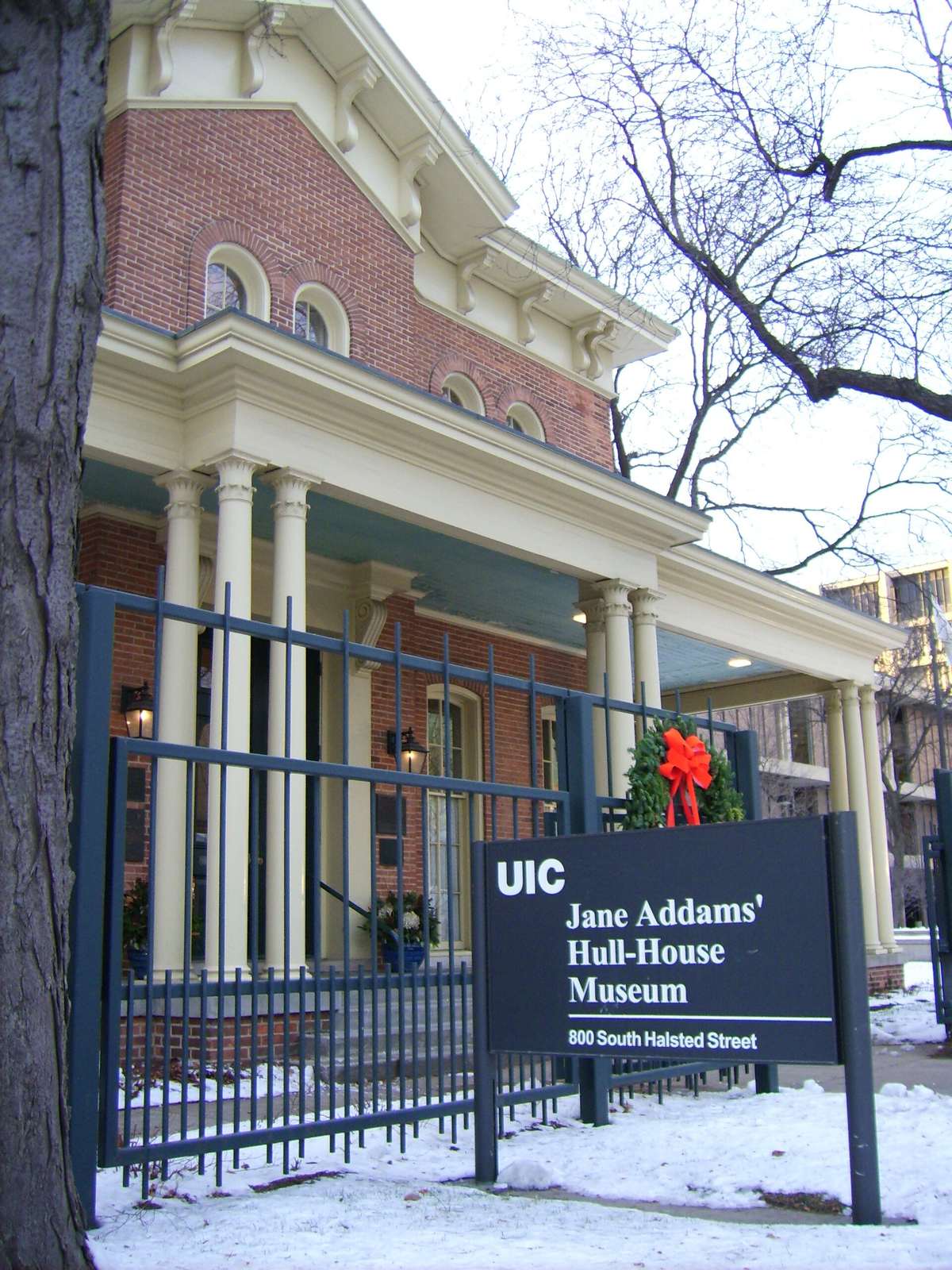
Hull House (officially Hull-House) in Chicago was the first settlement house in the United States: a home where educated volunteers lived among poor immigrant families and ran services for them. Jane Addams and Ellen Gates Starr founded it in 1889. Today its two surviving buildings hold the Jane Addams Hull-House Museum of the University of Illinois Chicago (UIC), at 800 S. Halsted Street on the Near West Side, on the UIC campus behind Student Center East. Admission is free, and the house tells how Chicago received newcomers long before today's immigrants arrived.
Hull House history: from an 1856 mansion to a museum
Charles J. Hull built the house in 1856. By the late 1800s it stood in the Nineteenth Ward on the Near West Side. The National Park Service (NPS) notes that Chicago's growth as a manufacturing city drew immigrants here, many of them into low-wage work in sweatshops and garment factories.
In 1888 Addams and Starr toured Europe and visited Toynbee Hall in London, an early settlement house. The visit gave them the idea. In 1889 they moved into the aging Hull mansion on Halsted Street. UIC Today also names Mary Keyser among the founders; the three lived alongside the communities they set out to help.
Over the next decades Hull House grew from one house into a 13-building complex covering an entire city block. According to the NPS, it held a gymnasium, a theater, an art gallery, libraries, pools, classrooms, a kindergarten and dormitories. Neighbors could get legal aid, use an employment office, leave children in childcare and learn crafts.
Hull House staff pushed for protective labor laws for women and children, for women's suffrage, and for better housing and sanitation in the ward. Addams worked against child labor and in 1915 founded the Women's International League for Peace and Freedom. In 1931 she won the Nobel Peace Prize, the second woman to receive it, according to NobelPrize.org. She died in Chicago in 1935.
Hull House became a National Historic Landmark in 1965 and was listed on the National Register of Historic Places in 1966. Two of the 13 buildings survive: the 1856 house and the Residents' Dining Hall, built in 1905 according to the City of Chicago's landmark record (UIC Today gives 1907). Both now house the UIC museum.
What to see at Hull House
- The 1856 Hull mansion. The house where the settlement began in 1889 and where its founders lived.
- The Residents' Dining Hall (1905). The second surviving building, where Hull House residents once took their meals.
- The Labor Museum legacy. UIC Today calls the Labor Museum one of the settlement's most successful arts programs: immigrant neighbors showed heritage crafts such as embroidery and knitting that were being lost in the surrounding communities. Two antique looms used to make textiles at the Labor Museum in the early 1900s are on display.
- Crafts and the bindery. Starr brought the principles of England's Arts and Crafts movement to Hull House and ran a bookbindery that valued slow handwork. The historic Hull House kilns were used to make ceramics by artisans of Mexican heritage.
- Changing exhibitions. Shows rotate; a past exhibit on Hull House arts education from 1889 to 1935 closed in July 2025. Check current exhibitions on the museum's website.
- Hull-House Books. The museum shop, open during museum hours.
Planning a full day? See our Chicago city guide.
How to get to Hull House
The nearest CTA train station is UIC-Halsted on the Blue Line, at 430 S. Halsted St. The station is accessible. From there the museum is a few blocks south along Halsted Street.
CTA buses #7, #8 and #60 connect at the station. The #8 Halsted bus runs along Halsted Street from 79th Street north to Waveland Avenue, so it works from both the North and South Sides. Schedules and reroutes are posted on the CTA site.
We found no current visitor parking rules on official pages; ask the museum before driving to campus.
Hours and tickets
| Item | According to UIC |
|---|---|
| Admission | Free |
| Tuesday to Friday | 10 a.m. to 4:50 p.m. |
| Saturday | Noon to 4:50 p.m. |
| Sunday, Monday | Not listed in the source |
| Reservations | You can reserve a date and time; walk-ins are welcome |
Hours and prices checked on November 11, 2026 on today.uic.edu (UIC's news site). The hours come from a 2024 UIC Today article; we could not open a newer official schedule, so they may have changed. Check hullhouse.uic.edu before you go.
Tips before you visit
- Coming with a group or set on a particular day? Reserve a date and time; UIC Today says reservations are possible, and walk-ins are welcome too.
- The museum sits on campus behind Student Center East. Use that building as your landmark when walking from UIC-Halsted.
- Hull-House Books keeps museum hours, so you can browse settlement history books on the same visit.
- Pair Hull House with other sights from our list of Chicago places to visit.
Questions people ask
Is the Jane Addams Hull-House Museum free?
Yes. UIC Today, the news site of the University of Illinois Chicago, says admission to the Jane Addams Hull-House Museum is free. You can reserve a date and time in advance, but walk-ins are welcome. Hours may change, so check hullhouse.uic.edu before you go.
What is the closest CTA station to Hull House?
The closest station is UIC-Halsted on the CTA Blue Line, at 430 S. Halsted St. The museum is at 800 S. Halsted Street, a few blocks south. CTA buses #7, #8 and #60 also stop at the station, and the #8 Halsted bus runs along Halsted Street.
Who founded Hull House and when?
Jane Addams and Ellen Gates Starr founded Hull House in 1889 in a mansion that Charles J. Hull built in 1856. An 1888 visit to Toynbee Hall, a settlement house in London, inspired them. UIC Today also names Mary Keyser among the founders.
How many Hull House buildings are left?
Two of the original 13 buildings survive: the 1856 Hull house and the Residents' Dining Hall from 1905. The complex once covered a whole city block on Halsted Street, with a theater, gymnasium, pools and a kindergarten. Both surviving buildings now hold the University of Illinois Chicago museum.
Places on the map
Sources
- Jane Addams Hull-House Museum (official site; did not load on 2026-11-11 via WebFetch, curl or Chrome)
- NPS: Hull-House (history, buildings, landmark designations)
- City of Chicago Landmarks: Jane Addams Hull-House (1856 house, 1905 Dining Hall)
- UIC Today, 2024: Lost to time: who made the crafts at Hull-House? (hours, free admission, Labor Museum)
- UIC Today, 2026: For UIC students: 10 ways to explore Chicago (location, buildings, reservations)
- NobelPrize.org: Jane Addams, Nobel Peace Prize 1931
- CTA: UIC-Halsted (Blue Line) station
- CTA: #8 Halsted bus