RussiansInUSA editorial team · Facts checked November 11, 2026 · Official site
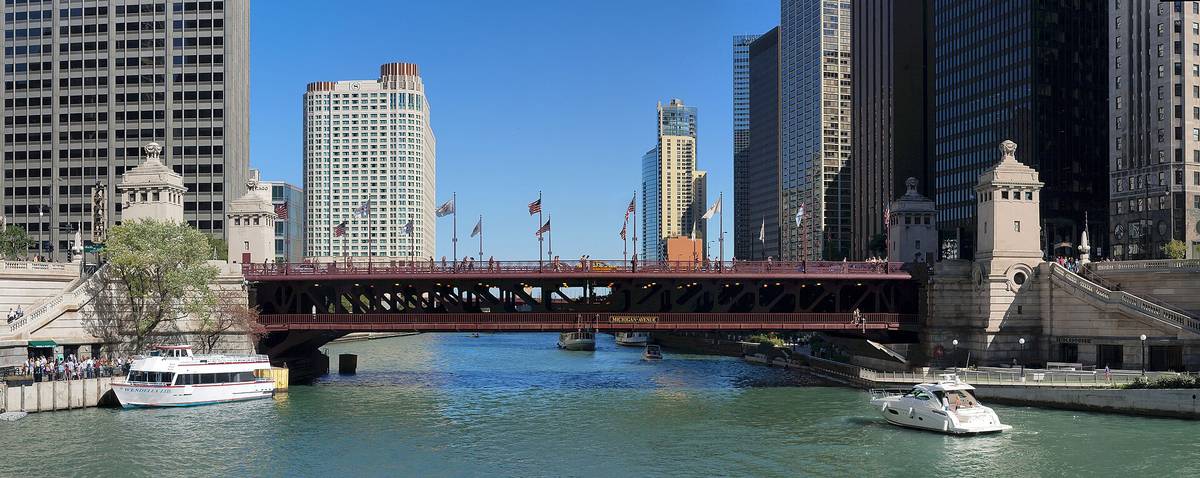
The DuSable Bridge, called the Michigan Avenue Bridge until 2010, carries Michigan Avenue over the main branch of the Chicago River at Wacker Drive. It links the Loop to the south with the Magnificent Mile to the north. Walking across is free at any time. People come for the four bridgehouses with their 1928 reliefs, the view down the river, and the museum inside one of the towers, where the gears that lift the bridge are on show. The museum is closed for the winter now and says it will reopen in spring 2027. For the city as a whole, see our Chicago page.
DuSable Bridge history: from Burnham's plan to 2010
According to the Commission on Chicago Landmarks, the bridge and upper Wacker Drive were conceived in Daniel Burnham's 1909 Plan of Chicago, to improve traffic and to improve the riverfront. The Chicago Architecture Center adds that the plan called for widening Michigan Avenue and extending it north of the river, where the street was then called Pine Street.
Edward H. Bennett designed the bridge and its four bridgehouses in the Beaux-Arts style, the museum says. The bridgehouse museum names the engineers as Hugh E. Young, Thomas Pihlfeldt and William A. Mulcahy. The Architecture Center says it was modeled on the Alexander III Bridge over the Seine in Paris.
| Year | What happened |
|---|---|
| 1909 | Bridge proposed in the Plan of Chicago |
| 1918 | Construction begins |
| 1920 | Bridge and bridgehouses open to traffic |
| 1926 | Wacker Drive esplanade completed |
| 1928 | Bas-relief sculptures installed on the bridgehouses |
| 1991 | Designated a Chicago Landmark with the esplanade (October 2) |
| 2006 | Friends of the Chicago River opens the museum in a bridgehouse |
| 2010 | Officially renamed the DuSable Bridge (October 15) |
The museum describes it as the first double-deck, double-leaf, fixed trunnion bascule bridge ever built: each leaf pivots on a pin and bearing and is balanced by a counterweight of about 12,000 tons, and each leaf is moved by a 108-horsepower motor.
The new name honors Jean Baptiste Point DuSable, whom the museum calls Chicago's first permanent resident; his homesite abuts the north end of the bridge. The south end sits next to the original site of Fort Dearborn.
In the 1920s the bridge lifted more than 3,000 times a year. Today, the museum says, it opens a few dozen times a year, in spring and fall, to let sailboats and other tall vessels pass between the river and Lake Michigan.
What to see on the bridge
The four bridgehouses carry the 1928 reliefs. The Chicago Architecture Center lists their subjects: the arrival of the French explorers Marquette and Joliet, the first settlers DuSable and John Kinzie, the Battle of Fort Dearborn, and the rebuilding after the 1871 fire. The Fort Dearborn scene, Defense by Henry Hering, is on the tower that now holds the museum.
The McCormick Bridgehouse & Chicago River Museum is run by Friends of the Chicago River, which has worked on the river since 1979. The visit starts at river level beside the bridge gears and spirals up five stories through the river's history to a 360-degree view of the city. Its address is 99 Chicago Riverwalk, at the northwest corner of Michigan Avenue and Wacker Drive. More sights are on our list of things to see in Chicago.
How to get to the DuSable Bridge
The bridge is at Michigan Avenue and Wacker Drive. The museum's address is 99 Chicago Riverwalk, Chicago, IL 60601.
| How | Where to get off | Then |
|---|---|---|
| CTA Red Line | Lake station, 188 N. State St. | walk east to Michigan Avenue and north to the river |
| CTA Blue Line | Clark/Lake | walk east to Michigan Avenue and north |
| CTA buses on Michigan Avenue | routes 11, 33, 125, 145, 146, 147, 151, 157 | stops at the bridge |
| Metra | Randolph Street Station | three blocks north to the river |
| Metra, other terminals | Union Station: bus 151; Ogilvie: 157; LaSalle Street: 125, 151 or 157 | to Michigan Avenue |
The museum's directions mention State/Lake, but the CTA says that station closed on January 5, 2026 for reconstruction into 2029; it points riders to Clark/Lake or Washington/Wabash, and to Washington/Wabash for transfers between the Red Line at Lake and the Loop 'L' lines. The CTA lists Lake as an accessible station. Check current service on transitchicago.com. Drivers are pointed by the museum to public parking at 111 E. Wacker Drive, and the museum recommends booking parking in advance through SpotHero.
Hours and tickets
The bridge is a public street and free to cross. Only the museum charges. The museum is closed now: its 2026 season ended on October 25, and it says it will reopen in spring 2027. The table shows last season's (2026) hours and prices; check the 2027 ones before you go.
| What | When | Price |
|---|---|---|
| Museum, self-guided | 2026 season: May 9 to October 25, Wednesday to Sunday, 10 am to 5 pm | pay what you can, suggested $5 to $10 |
| Guided tour | June to October, Wednesday to Sunday, 11 am and 2 pm | $15 |
| Bridge lift from inside the tower | select Saturdays (October 3 and 10 in 2026), museum opens 9:15 am | $15, registration required |
| Friends of the Chicago River members | during open hours | free |
Hours and prices checked November 11, 2026 on bridgehousemuseum.org. Season dates, hours, prices and lift days change every year, so always check the museum's visit page before you go.
Tips before you go
- Saturday lifts are expected between 9:30 and 10:00 am, but the museum does not guarantee the time. Registration is required; refunds are available up to three days before.
- On Wednesdays only the north leaf lifts. There are no lift reservations then, but the museum is open in the morning to watch boats.
- The museum links to the full lift schedule on chicagoloopbridges.com. It warns that even a scheduled lift is not guaranteed: the city can cancel it.
- Seniors 62 and over get a discount with the code Senior2026.
- The museum spirals five stories and its site does not mention an elevator, so call (312) 977-0227 if access matters to you.
Questions people ask
Why is the Michigan Avenue Bridge called the DuSable Bridge?
On October 15, 2010 the Michigan Avenue Bridge was officially renamed the DuSable Bridge, honoring Jean Baptiste Point DuSable. The bridgehouse museum calls him Chicago's first permanent resident and says his homesite abuts the north end of the bridge, while the south end sits next to the original Fort Dearborn site.
How much is the museum inside the DuSable Bridge?
The museum is closed until spring 2027. In the 2026 season the McCormick Bridgehouse & Chicago River Museum was pay what you can for a self-guided visit, with a suggested donation of $5 to $10. A guided tour cost $15, and watching a bridge lift from inside the tower also cost $15 with registration. Friends of the Chicago River members get in free. Check 2027 prices on the museum's site.
When can you see the Michigan Avenue bridge go up?
Chicago River bridges lift in spring and fall to let sailboats pass between the river and Lake Michigan. In 2026 the bridgehouse museum offered lift viewings on Saturday, October 3 and Saturday, October 10, with the lift expected between 9:30 and 10:00 am. The museum posts each season's dates on its website.
What is the closest train station to the DuSable Bridge?
State/Lake is closed for reconstruction from January 2026 into 2029, so the CTA suggests Clark/Lake or Washington/Wabash instead. The Red Line's Lake station on State Street is also close; walk east to Michigan Avenue and north to the river. CTA buses 146, 147 and 151 run along Michigan Avenue.
Places on the map
Sources
- McCormick Bridgehouse & Chicago River Museum
- McCormick Bridgehouse & Chicago River Museum: About the Bridge
- McCormick Bridgehouse & Chicago River Museum: About the Museum
- McCormick Bridgehouse & Chicago River Museum: Plan a Visit
- McCormick Bridgehouse & Chicago River Museum: Bridge Lifts
- McCormick Bridgehouse & Chicago River Museum: Getting Here
- City of Chicago, Chicago Landmarks: Michigan Avenue Bridge and Esplanade
- Chicago Architecture Center: Michigan Avenue Bridge (DuSable Bridge)
- CTA: State/Lake station
- CTA: Lake (Red Line) station