RussiansInUSA editorial team · Facts checked November 11, 2026 · Official site
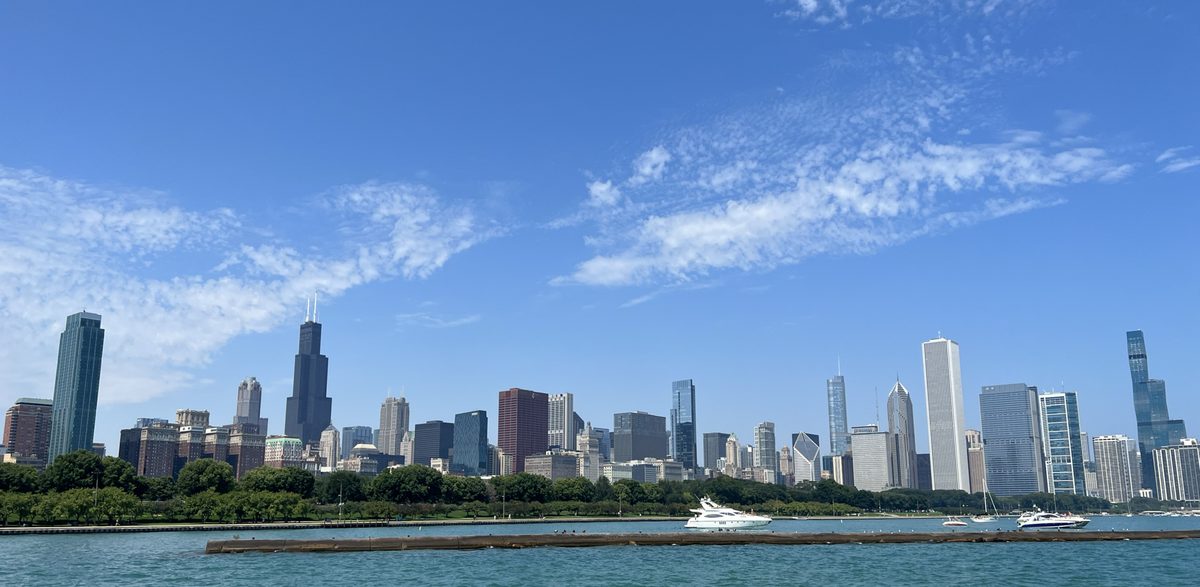
The Chicago Loop is Chicago's historic downtown: the tight grid of towers on the south bank of the Chicago River, between the river and Grant Park. It holds the city's first skyscrapers, the ring of "L" train tracks, City Hall, State Street and the theater district. There is no gate and no ticket: it is a neighborhood, free to walk at any hour. The Chicago city page covers the rest of the city.
Its edges depend on who you ask. The Commission on Chicago Landmarks describes the Loop as the area bounded by the Chicago River on the north and west, Grant Park on the east and Congress Parkway on the south. Chicago Loop Alliance, the district's business group, puts the south edge at Ida B. Wells Drive and the east edge at the lakefront.
Chicago Loop history: the name and the first skyscrapers
According to the landmarks commission, the name "Loop" is said to come from a cable car line that circled the central business district before the raised "L" tracks were built. The word later stuck to the "L" ring.
The Great Fire of 1871 destroyed the center of the city. Afterward, the commission writes, the Common Council banned wooden buildings within city limits. Chicago grew to half a million people, business crowded into the center, land prices climbed and owners built upward, helped by new engineering, electricity and elevators. The swampy ground made foundations a real problem. The commission says the first building called a skyscraper was the 10-story Montauk Building of 1882, since demolished.
The Loop "L" formally opened on October 3, 1897. The CTA says three of the four early "L" companies ran on it that day: the South Side, Metropolitan West Side and Lake Street lines. The Northwestern "L" joined in 1900.
Today the Loop is still the business center and an open-air architecture museum. The city's Loop Tour covers some three dozen landmarks, from post-1871 buildings through early steel-frame skyscrapers to Art Deco towers of the 1920s and 1930s, by Daniel Burnham, Holabird & Roche, William Le Baron Jenney, John Wellborn Root and Louis Sullivan.
What to see in the Loop
Every building below is an official Chicago Landmark; addresses and dates come from the commission's pages.
| Building | Address | Built | Why go |
|---|---|---|---|
| Rookery Building | 209 S. LaSalle St. | 1885-1888 | Burnham & Root, lobby remodeled by Frank Lloyd Wright in 1905-07 |
| Monadnock Block | 53 W. Jackson Blvd. | 1889-1893 | north half on six-foot-thick masonry walls, south half steel frame |
| Reliance Building | 32 N. State St. | 1890, 1894-95 | 14 stories of mostly glass, an ancestor of glass towers |
| Carson, Pirie, Scott and Company Building | 1 S. State St. | 1898-1904 | Louis Sullivan's store with cast-iron ornament |
| Chicago Cultural Center | 78 E. Washington St. | 1897 | former central library, two Tiffany stained-glass domes |
| Chicago Theatre | 175 N. State St. | 1921 | oldest surviving movie palace in Chicago |
| Daley Center | 50 W. Washington St. | 1965 | Picasso sculpture on the plaza, unveiled 1967 |
The Rookery takes its name from a temporary City Hall and water tank put up on the site after the fire; pigeons roosted on them, and people called them "the rookery." The Monadnock shows two eras in one block: the commission calls its north half the last skyscraper built on load-bearing walls. The Reliance is clad in cream terra cotta and filled with "Chicago windows," a wide fixed pane between narrow sashes that open. At Carson Pirie Scott, built for the Schlesinger and Mayer store, look at Sullivan's cast iron on the lower two floors.
The Cultural Center was built as the first permanent home of the public library and as a Civil War memorial. It now hosts free exhibitions, concerts and talks. The Daley Center was the first skyscraper skinned in self-weathering Cor-Ten steel, and the Picasso sculpture outside is made of the same steel.
Quincy station, the 1897 "L"
For the Loop as it looked when the "L" opened, get off at Quincy (Wells and Quincy). A. M. Hedley designed it in 1896 and it opened with the Loop on October 3, 1897. A 1988 restoration rebuilt the ticket agent booths from 1897 plans. It became a Chicago Landmark in 2017, and an $18.2 million project finished in 2018 added elevators. The Brown, Orange, Pink and Purple lines stop there.
How to get to the Loop
The Loop is the hub of Chicago transit. Chicago Loop Alliance counts five Metra commuter stations in and near the Loop, where all 11 Metra lines end.
- From O'Hare: the CTA Blue Line runs to the Loop 24/7; CTA puts the trip at 40-45 minutes.
- From Midway: the Orange Line. CTA says it runs every day except overnight hours, when the N62 Archer bus fills in.
- To the Cultural Center: "L" lines on the ring to Washington/Wabash and walk east; subway to Lake (Red Line) or Washington (Blue Line).
- By river: Shoreline Water Taxi and Chicago Water Taxi by Wendella.
- By bike: Divvy, which you can return to any station in the city.
- By car: garages, lots and metered street parking. Near the Cultural Center the city lists Grant Park North (25 N. Michigan Ave.), Grant Park South (325 S. Michigan Ave.) and Millennium Park (5 S. Columbus Dr.) garages.
Hours and tickets
The district itself is open around the clock and free. Only single buildings and transit have hours and prices.
| What | Hours | Price |
|---|---|---|
| Loop streets, facades, Daley Plaza Picasso | always open | free |
| Chicago Cultural Center | daily 10 a.m. to 5 p.m., closed holidays | free |
| One CTA "L" ride | line schedule | $2.50 |
| One CTA bus ride | route schedule | $2.25 |
| CTA/Pace 1-Day pass | from first use | $5 |
| CTA/Pace 3-Day pass | from first use | $15 |
Hours and prices checked November 11, 2026 on chicago.gov and transitchicago.com.
Pay with a Ventra account or tap a contactless bank card or phone; passes cannot be bought that way. Cultural Center exhibitions close 15 minutes before the building does, and formal posed photo shoots there now need a city permit applied for at least two weeks ahead. For street closures check Chicago Loop Alliance's advisories, and see more Chicago sights.
Questions people ask
Why is downtown Chicago called the Loop?
According to the Commission on Chicago Landmarks, the name is said to come from a cable car route that circled the central business district before the raised "L" tracks existed. In 1897 the Loop "L" closed its ring around the same blocks, and "the Loop" became the name for the whole historic downtown.
Do you need a ticket to visit the Chicago Loop?
No. The Loop is a city district of public streets and plazas, free to walk at any time. You pay only for transit and for some venues. The Chicago Cultural Center at 78 E. Washington St. is free and open daily from 10 a.m. to 5 p.m., closed on holidays.
How do I get from O'Hare to the Loop?
Take the CTA Blue Line, which Chicago Loop Alliance says connects O'Hare and the Loop 24/7. A single "L" ride costs $2.50, paid with Ventra or a contactless bank card. From Midway Airport the CTA Orange Line runs to the Loop, but not overnight, when the N62 Archer bus replaces it.
Which Loop buildings should I see first?
A short walk covers the essentials: the Rookery on LaSalle Street with its Frank Lloyd Wright lobby, the Monadnock Block on Jackson Boulevard, the glassy Reliance Building and Sullivan's Carson Pirie Scott store on State Street, then the Chicago Cultural Center with its Tiffany domes. All are official Chicago Landmarks.
Places on the map
Sources
- Chicago Loop Alliance
- Chicago Loop Alliance: Get around the Loop
- Commission on Chicago Landmarks: The Loop Tour
- Commission on Chicago Landmarks: Early Skyscrapers Tour
- Chicago Landmarks: Rookery Building
- Chicago Landmarks: Monadnock Block
- Chicago Landmarks: Reliance Building
- Chicago Landmarks: Carson, Pirie, Scott and Company Building
- Chicago Landmarks: Chicago Public Library/Cultural Center
- Chicago Landmarks: Chicago Theater
- Chicago Landmarks: Daley Center
- City of Chicago DCASE: Chicago Cultural Center
- CTA: Quincy station improvements
- CTA: Fares
- CTA: Trains to O'Hare and Midway