RussiansInUSA editorial team · Facts checked November 11, 2026 · Official site
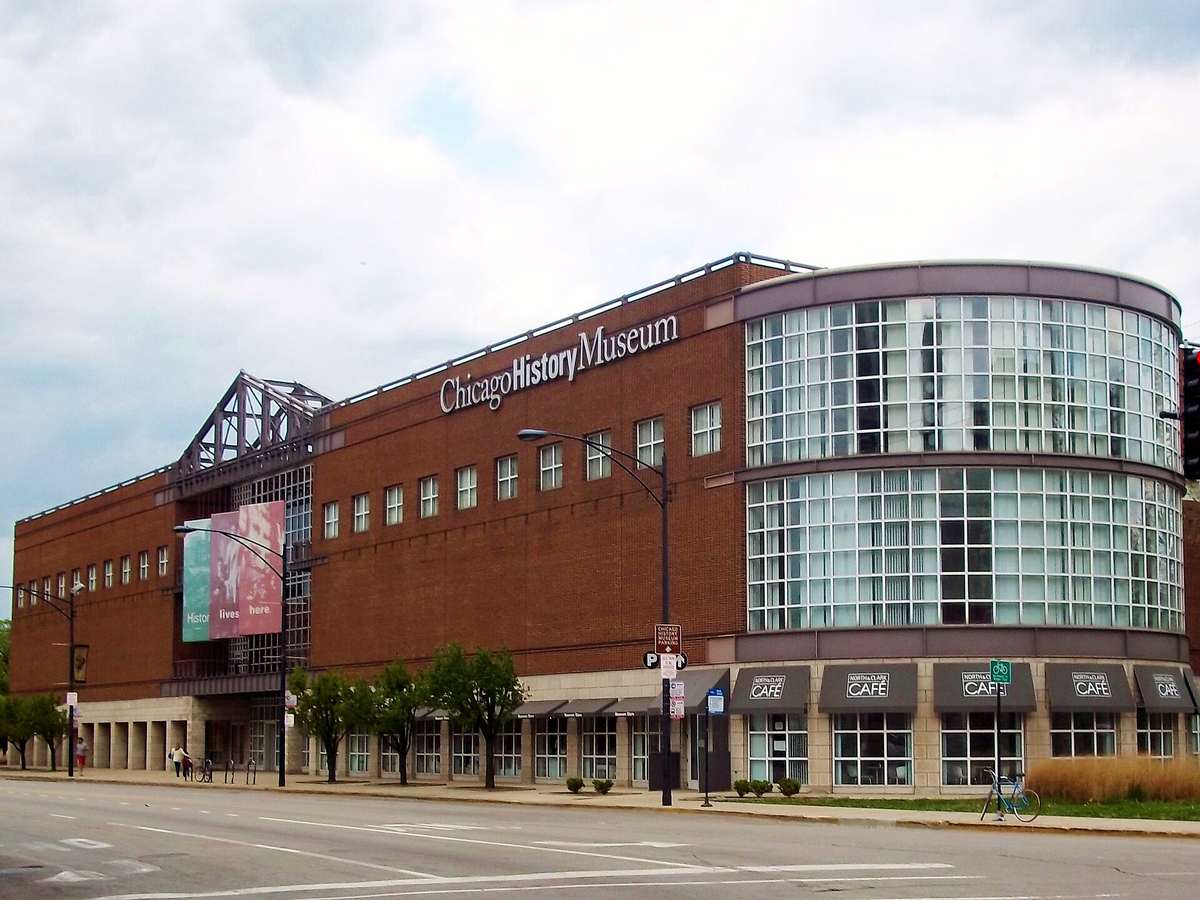
The Chicago History Museum tells how Chicago grew from a trading post into a major city. It stands in Lincoln Park on the North Side, at 1601 N. Clark Street, at the corner of Clark Street and North Avenue. People come for the bed Abraham Lincoln died in, L car no. 1, and dioramas made in the 1930s. Illinois residents 18 and under get in free. For the rest of the city, see our Chicago city guide.
Chicago History Museum history: from the Historical Society to today
The museum began as the Chicago Historical Society. The museum says it was founded in 1856 and incorporated by an act of the state legislature in 1857. Its first building stood at Dearborn and Ontario Streets.
Two fires followed. The Great Chicago Fire of 1871 destroyed the building and most of the collection, and another fire three years later took most of what was left. The Society worked from temporary buildings on the same site until 1896, when it built a stone edifice designed by Henry Ives Cobb, with the Gilpin Library and exhibition space.
In 1920 the Society bought manuscripts, paintings and artifacts from the estate of Charles F. Gunther, among them the bed Lincoln died in and George Washington's compass.
In 1932 the museum moved to Lincoln Park. Its Georgian colonial building, by Graham, Anderson, Probst & White, was planned by the trustees in the late 1920s as a $1 million museum to mark the city's centennial. A limestone addition by Alfred Shaw and Associates followed in 1972; in 1988 Holabird and Root wrapped it in red brick and added underground storage and new galleries.
In February 2006 the Society became the Chicago History Museum, and later that year it reopened with a new lobby, the new exhibitions Chicago: Crossroads of America and Sensing Chicago, and its restored dioramas. Today, the museum says, it serves thousands of school groups a year, and its Abakanowicz Research Center serves thousands of researchers.
What to see at the Chicago History Museum
The museum lists 13 in-person exhibitions. The permanent ones worth a first visit:
- Chicago: Crossroads of America (2nd floor). L car no. 1 greets visitors at the entrance. Five themed areas cover trade and culture, crises and unrest, how communities unite and divide, Chicago inventions, and the city at play. The museum says plainly that it is a selection of stories, not a complete history.
- Abraham Lincoln (2nd floor). The 1860 election, the Civil War and the assassination. The centerpiece is the bed in which Lincoln died on April 15, 1865, at William Peterson's house in Washington, DC, along with a torch and ceremonial ax from 1860 campaign parades and a life mask by sculptor Clark Mills.
- Lincoln's Chicago. Chicago as Lincoln's second home and political headquarters.
- Imagining Chicago: The Dioramas (1st floor, Tawani Foundation Diorama Hall). Seven dioramas built by German artisans in the early 1930s from maps, photographs and letters, showing Chicago from an 1804 trading outpost to the 1893 World's Columbian Exposition, including Sauganash Tavern (1833), Rush Street Bridge (1860) and the Great Chicago Fire (1871). No other artifacts have been on display at the museum longer.
- Sensing Chicago (1st floor). A hands-on gallery for children, in English and Spanish: be a firefighter in the 1871 fire, hear the L rush past, smell the wild onion that gave Chicago its name, catch a fly ball at Comiskey Park and climb into a giant Chicago-style hot dog.
- Facing Freedom. Women's suffrage, labor unions, freedom seekers and a citywide school boycott.
Temporary shows change. Threads of a Nation: Preserving Presidential Clothing, on how conservators protect garments of George and Martha Washington, John Adams, and Abraham and Mary Lincoln, runs on the 2nd floor until July 18, 2027. Outside, the Richard M. and Shirley H. Jaffee History Trail is an interpretive path through the park around the museum. Check the current exhibitions list and our list of places to see in Chicago.
How to get there
The address is 1601 N. Clark Street, Chicago, IL 60614. The museum says CTA buses 22, 36, 72, 73, 151 and 156 stop nearby; the 22 Clark has overnight (Owl) service, according to CTA.
The nearest train stations are about half a mile away:
- Sedgwick on the Brown Line, 1536 N. Sedgwick St., listed by CTA as accessible.
- Clark/Division on the Red Line, 1200 N. Clark St. CTA lists it as accessible, but its street elevator can be temporarily out of service, so check CTA alerts.
Drivers can use the public garage one block north at 1730 N. Stockton Drive, near Clark and LaSalle; it costs $10 with museum validation.
Hours and tickets
| Hours | |
|---|---|
| Monday | Closed, except select Mondays and commemorative days |
| Tuesday to Saturday | 9:30 am to 4:30 pm |
| Sunday | Noon to 5:00 pm |
| New Year's Eve, Thanksgiving Eve, Christmas Eve | 9:30 am to 2:30 pm |
| Fourth of July | 9:30 am to 4:30 pm |
| New Year's Day, Thanksgiving, Christmas | Closed |
| Ticket | Chicago resident | Non-Chicago resident |
|---|---|---|
| Adults | $19 | $24 |
| Seniors 65+ | $17 | $20 |
| Students 19 to 22 | $17 | $20 |
| Ages 13 to 18 from outside Illinois | - | $20 |
| Ages 12 and under | Free | Free |
| Illinois residents 18 and under | Free | Free |
| Members | Free | Free |
Hours and prices checked November 11, 2026 on chicagohistory.org.
Chicago resident prices and free entry for Illinois youth need proof of residency. EBT cardholders and WIC participants pay $3. Active-duty military and veterans, Illinois teachers, Chicago police and fire personnel, and students and staff of some universities get in free with ID. The museum holds Illinois resident free days through the year, including commemorative days such as Martin Luther King Jr. Day, Presidents' Day and the Fourth of July. Upcoming dates are posted on the Visit page below the prices; check them before you go.
Tips for your visit
- Backpacks, umbrellas, food and drinks go to the free coat check.
- Large backpack-style camera bags, tripods, monopods and selfie sticks are not allowed in galleries; amateur photography is fine everywhere.
- There is no last entry time, and admission is good all day, so you can leave and come back.
- The museum says a first visit takes about two hours.
- The North & Clark Café is open Tuesday to Sunday and closes about an hour before the museum.
- Gallery tours depend on guide availability, so call (312) 642-4600 first. Groups of 10 or more adults should book ahead.
- The Abakanowicz Research Center is usually open Wednesday to Saturday, but its hours change by season and around holidays and are posted on its own page. It is free, no appointment needed; children under 6 are not admitted.
Questions people ask
How much are tickets to the Chicago History Museum?
Adult admission is $24, or $19 for Chicago residents with proof of residency. Seniors 65 and over and students 19 to 22 pay $20, or $17 as Chicago residents. Children 12 and under and Illinois residents 18 and under are free, and EBT and WIC participants pay $3. Prices were checked on November 11, 2026.
Where is Lincoln's deathbed in Chicago?
The bed in which Abraham Lincoln died on April 15, 1865, is in the permanent Abraham Lincoln exhibition on the second floor of the Chicago History Museum. The museum bought it in 1920 with the Charles F. Gunther collection. Nearby are items from the 1860 campaign and a life mask by Clark Mills.
Does the Chicago History Museum have free days?
Yes, for Illinois residents. The museum offers free days through the year, including Martin Luther King Jr. Day, Presidents' Day and the Fourth of July. Upcoming dates are posted on the museum's Visit page just below the admission prices.
How long does a visit take?
The museum estimates about two hours for a first visit. There is no last entry time and a ticket is good all day, so you can step out into Lincoln Park and return. Hours are Tuesday to Saturday 9:30 am to 4:30 pm and Sunday noon to 5 pm.
Places on the map
Sources
- Chicago History Museum
- Chicago History Museum: Visit Us (hours, admission, parking, transit, policies)
- Chicago History Museum: Museum History
- Chicago History Museum: Exhibitions
- Chicago History Museum: Chicago: Crossroads of America
- Chicago History Museum: Abraham Lincoln
- Chicago History Museum: Imagining Chicago: The Dioramas
- Chicago History Museum: Sensing Chicago
- CTA: Sedgwick Station
- CTA: 22 Clark
- CTA: Clark/Division Station
- Chicago History Museum: Abakanowicz Research Center