RussiansInUSA editorial team · Facts checked November 11, 2026
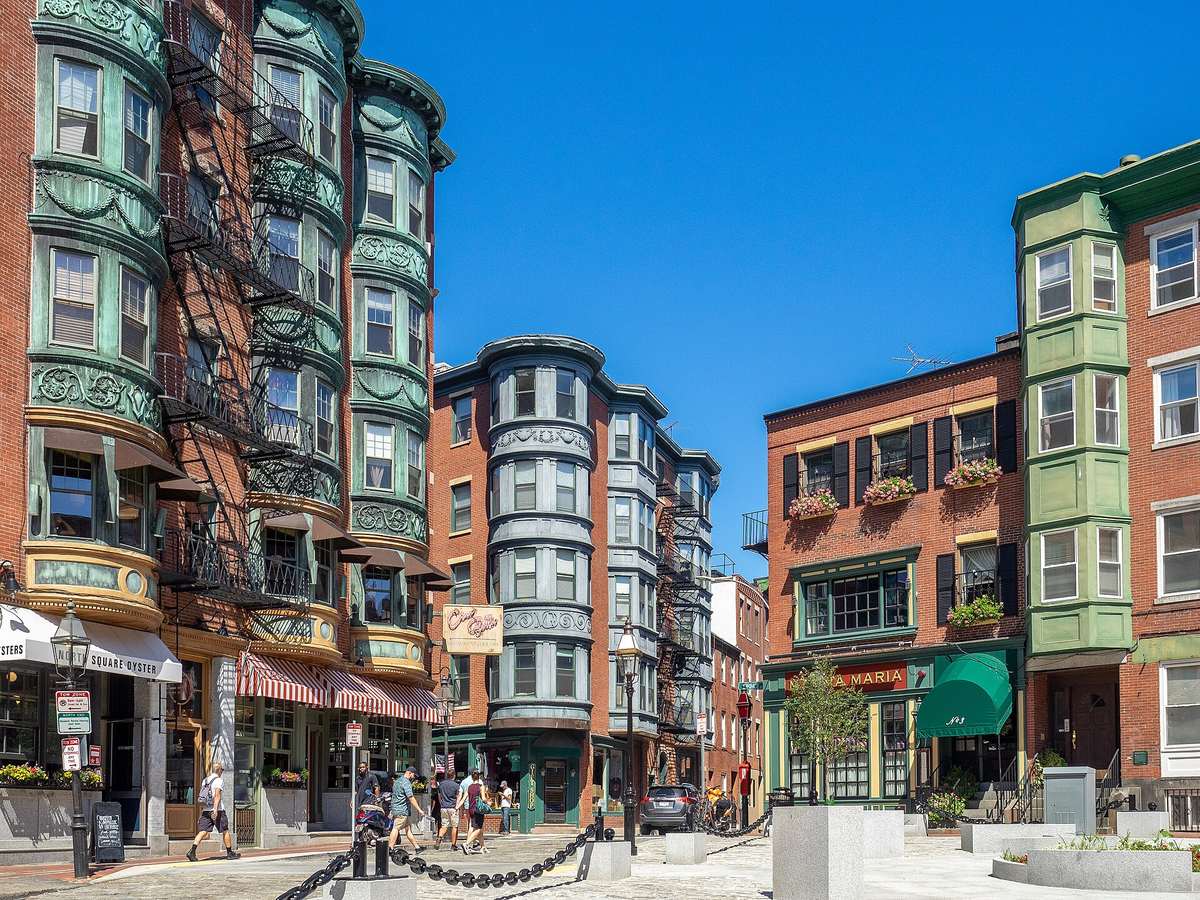
The North End is Boston's oldest residential neighborhood and its Little Italy. It sits on the harbor, and its main streets, Hanover and Salem, start a few minutes' walk from Faneuil Hall. The Paul Revere House, Old North Church and Copp's Hill Burying Ground are here, and the Freedom Trail runs through it. The City of Boston calls the North End one of its most visited neighborhoods and the hub of the city's Italian-American community. Our Boston city page has the short version.
North End history: from colonists to Little Italy
The North End was one of colonial Boston's first residential areas, and the National Park Service calls it the city's oldest residential neighborhood. In the 18th century it was home to elite families, including those of Governor Thomas Hutchinson and the silversmith Paul Revere. His house, built about 1680, is downtown Boston's oldest residence. Revere and his family owned and lived in it most of the time from 1770 to 1800.
After the Revolution, loyalists left and wealthy families moved to Beacon Hill, and the neighborhood declined. According to Boston College's Global Boston project, Irish immigrants began settling here in the 1820s. St. Mary's Catholic Church opened on Endicott Street in 1836, and the city's first Irish enclave grew around it. The Great Famine sped up emigration in the 1840s. By 1850 the Irish were more than half the population.
After the Civil War new groups arrived. Genoese from northern Italy settled around Ferry Court from the 1860s, followed a decade or two later by people from Sicily, Calabria and Campania, who lived on North Street and North Bennett Street. A community of several hundred Azoreans lived on Fleet Street from the 1880s to World War I, and Greeks settled on Commercial Street. By 1920, Italian immigrants and their children were roughly 90 percent of the North End's population and owned more than half its residential property. It had one of the highest population densities in the world.
Jewish immigrants from the Russian Empire
Global Boston says Russian and Polish Jews came in the 1860s and 1870s, at the same time as the Italians, and by 1895 the two groups together outnumbered the Irish. Jewish families lived in the triangle between Hanover, Endicott and Prince Streets, with a cluster of synagogues and businesses on Salem Street. After 1900 they moved on to the South End, the West End and Roxbury, and Italians took their place.
The 1919 molasses flood and the 20th century
At about 1 pm on January 15, 1919, a 50-foot tank built in 1915 by the Purity Distilling Company burst in the North End. The City of Boston says 2.3 million gallons of molasses swept through the neighborhood at about 35 miles per hour. It killed 21 people, including two 10-year-old children, and injured 150. The wave knocked a train off the overhead railway and pushed a firehouse and other buildings off their foundations. The owners blamed anarchists at first, but in 1925 a court-appointed auditor found them negligent. The city links the disaster to rules requiring engineers to sign and seal plans and building inspectors to check projects.
From the 1930s the population fell, as immigration was restricted by law and Italian families moved to East Boston, Chelsea and the northern suburbs. In the early 1950s, building the Central Artery and the Callahan Tunnel cost more than a hundred families their homes. New investment came in the 1970s, around the bicentennial. Rents rose until older residents found it hard to stay, but the Italian shops and restaurants remained.
What to see in the North End
- Paul Revere House, 19 North Square. Built about 1680, it was a cigar factory and a bank before its restoration in 1908. The neighboring Pierce/Hichborn House is closed until further notice.
- Old North Church, 193 Salem Street. On the evening of April 18, 1775, the night of Revere's ride, lanterns were placed in its steeple. More on it in what to see in Boston.
- Copp's Hill Burying Ground, Hull Street. Laid out in 1659 as the second burial ground on the Boston peninsula, it is named for the shoemaker William Copp and holds more than 10,000 people. Among them are Increase and Cotton Mather; Robert Newman, who placed the lanterns at Christ Church (Old North's formal name); Edmund Hartt, builder of USS Constitution; and Prince Hall, anti-slavery activist and founder of the Black Masonic Order. The northwest section was set aside for Black Bostonians, free and enslaved. In 1775 the British built a battery here and shelled Bunker Hill and Charlestown. Round scars on Capt. Daniel Malcolm's gravestone are often read as musket-ball marks (cemetery page on boston.gov).
- Hanover and Salem Streets. The city says the North End has some of Boston's best restaurants and old-world cafes.
- The waterfront. A skating rink, baseball fields and the Mirabella Pool, one of only two outdoor pools run by Boston Centers for Youth and Families, open in summer.
- Saint Anthony's Feast. Every late August, a society founded by Italian immigrants in 1919 holds a four-day feast for Saints Anthony and Lucy, with processions, Masses, music, and Italian and American food. The Grand Procession starts on Endicott Street.
How to get to the North End
The T is easiest. Haymarket station (136 Blackstone Street) is on the Orange and Green Lines and has elevators (station page on mbta.com). The Paul Revere House also suggests Aquarium on the Blue Line and Government Center on the Green and Blue Lines. North Station is a 10 to 15 minute walk away. On foot, the house is about ten minutes from Faneuil Hall along the Freedom Trail's red line.
Driving is hard: the streets are narrow and parking is very limited. There are metered spaces on Commercial Street and pay lots. Put "North Square" in your GPS, not "North Street", or you will end up in the wrong place. Bluebikes stations are at Cross Street and Hanover Street and at Lewis Wharf. Check service alerts on mbta.com before you go: lines are sometimes closed for repairs, and the Orange Line is then the backup.
Hours and tickets
The neighborhood itself is free and always open.
| What | Hours | Price |
|---|---|---|
| Paul Revere House, November 1 to April 14 | 10:00 am to 4:15 pm; closed Mondays in January, February and March | adults $6, seniors and college students $5.50, children 5 to 17 $1 |
| Paul Revere House, April 15 to October 31 | 10:00 am to 5:15 pm daily | same |
| Paul Revere House, holidays | closed Thanksgiving, December 24 and 25, January 1 | |
| Old North Church | Tuesday to Saturday 10 am to 5 pm, Sunday 12:30 to 5 pm | adults $10, youth $5, 5 and under free |
| Copp's Hill Burying Ground | daily, about 9 am to 4 pm | free |
Hours and prices checked on November 11, 2026 at paulreverehouse.org, oldnorth.com and boston.gov. Revere House tickets are sold at the booth on arrival; only groups of 10 or more need to reserve. Cash is preferred, and cards are taken for $10 or more.
Tips before you go
At the Paul Revere House, photos are allowed only in the outdoor courtyard, not inside the historic buildings, and the same goes for food, drinks and gum. There are ATMs on Hanover Street, one block from the museum. For Saint Anthony's Feast, the society's site posts the dates and the procession schedule.
Questions people ask
How much does the Paul Revere House cost?
Admission to the Paul Revere House at 19 North Square is $6 for adults, $5.50 for seniors and college students and $1 for children 5 to 17. Tickets are sold at the booth on arrival, and only groups of 10 or more need a reservation. Prices were checked on November 11, 2026 at paulreverehouse.org.
Why is the North End called Little Italy?
Italians arrived from the 1860s, first from Genoa and then from Sicily, Calabria and Campania. Boston College's Global Boston project says that by 1920 Italian immigrants and their children made up roughly 90 percent of the North End's population. The City of Boston still calls it the hub of the Italian-American community.
Did immigrants from Russia live in the North End?
Yes. According to Global Boston, Russian and Polish Jews settled in the North End in the 1860s and 1870s, between Hanover, Endicott and Prince Streets, with synagogues and businesses on Salem Street. After 1900 most moved to the South End, the West End and Roxbury.
What was the Boston molasses flood?
On January 15, 1919, a 50-foot Purity Distilling tank burst in the North End and sent 2.3 million gallons of molasses through the neighborhood at about 35 miles per hour. The City of Boston says 21 people died and 150 were injured. In 1925 a court-appointed auditor found the owners negligent.
Places on the map
Sources
- North End, City of Boston
- Copp's Hill Burying Ground, City of Boston
- 100 years ago today: molasses crashes through Boston's North End, City of Boston
- Paul Revere House, National Park Service
- Haymarket station, MBTA
- The North End, Global Boston, Boston College
- Hours & Prices, Paul Revere House
- Map & Directions, Paul Revere House
- Before You Arrive, Paul Revere House
- Copp's Hill Burying Ground, Freedom Trail Foundation
- Saint Anthony's Feast, Boston North End
- Visit, Old North Church
- Old North Church, National Park Service