RussiansInUSA editorial team · Facts checked November 11, 2026 · Official site
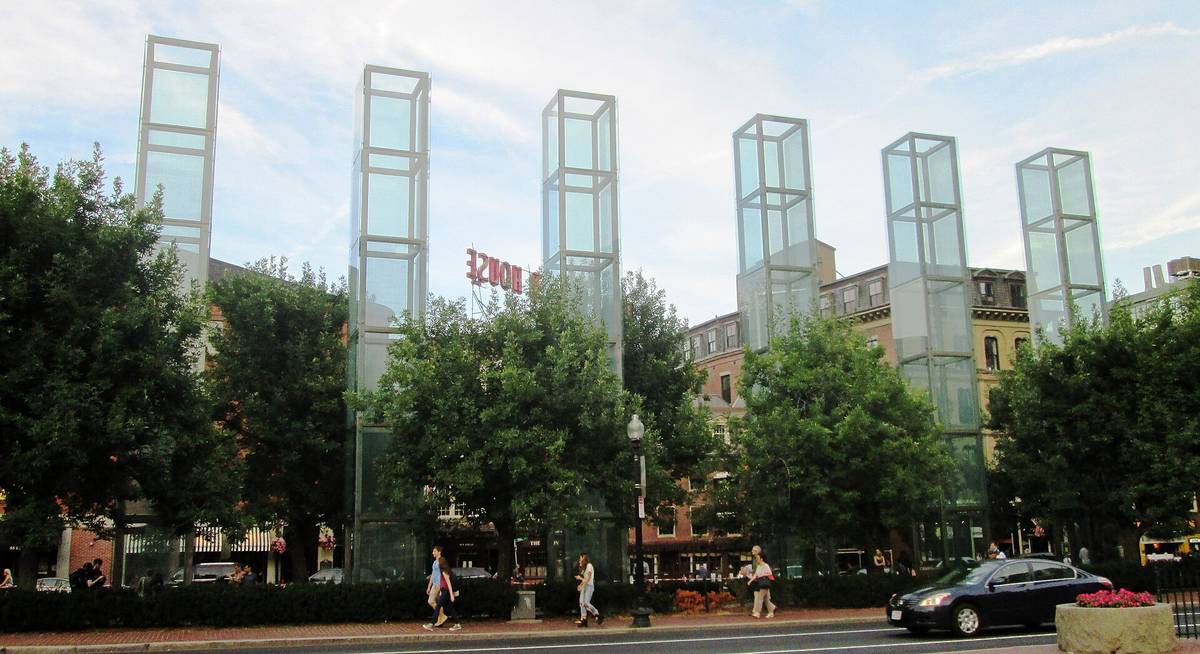
The New England Holocaust Memorial in Boston is a set of six glass towers, each 54 feet tall, in a small park on Union Street next to Faneuil Hall and Quincy Market. The address is 98 Union St., Boston, MA 02129. It is outdoors, open at all hours and sits directly on the Freedom Trail, so it fits easily into a walk through downtown.
History of the memorial
The memorial began with Stephan Ross, born Szmulek Rozental. According to the memorial's website, he was imprisoned at age nine and survived 10 concentration camps between 1940 and 1945. American troops liberated him from Dachau at age 14. The Nazis murdered his parents, a brother and five sisters; his brother Harry was the only other family member to survive. In 1948, at 16, he came to America through the U.S. Committee for Orphaned Children. He earned three college degrees and worked for the City of Boston for more than 40 years.
With the encouragement of Jewish and Christian colleagues at the City of Boston, Ross formed a committee to draft a proposal for a memorial. World War II veteran William Carmen became its chairman, and Israel Arbeiter, president of the American Association of Jewish Holocaust Survivors of Greater Boston, joined. Mayors Raymond Flynn and Thomas Menino backed the effort.
Architect Stanley Saitowitz won the global design competition, which drew more than 500 entries. The memorial was dedicated on October 22, 1995, in a public ceremony on the steps of Boston City Hall Plaza. According to the site, Ross wanted to memorialize his family among the six million Jewish victims and other innocent people who lost their lives in the Holocaust, and wanted the memorial to serve as a lesson to future generations. The site also names the soldiers who liberated the camps among those the memorial honors.
Today Combined Jewish Philanthropies (CJP) manages and maintains the memorial, and the Jewish Community Relations Council (JCRC) runs its educational programs.
What to see at the memorial
Saitowitz describes the memorial as "built with light." Look for these elements:
- Six glass towers, each 54 feet high and lit from inside, top to bottom. The architect calls them emblems of faith.
- Numbers in the glass. Millions of numbers are etched into the glass, recalling the tattoos on many victims' arms. The path leads through the towers, and the shadows of the numbers fall on the people walking it.
- Survivor memories. A memory from a survivor of each camp is etched on the walls of each tower.
- Six fire pits lined with black concrete, each with a glowing fire at the bottom, named for the death camps Chelmno, Treblinka, Majdanek, Sobibor, Auschwitz-Birkenau and Belzec.
- Black granite ramps with the word REMEMBER cut into them.
- Two entries with panels: one gives a chronology of events leading to the Wannsee Conference, the other quotes Pastor Martin Niemoller.
- A line of text between the towers that places the Holocaust in historical context.
- Tree stumps. In the architect's words, the horror of the Holocaust is reenacted in the cutting of all the trees on half the site. The stumps remain.
The memorial is open at all hours, and the towers are lit from inside.
How to get there
The memorial is in Carmen Park (listed on Google Maps as Union Street Park I), on Congress Street. The memorial's site lists these MBTA subway stations within walking distance:
| Line | Station | Walk |
|---|---|---|
| Orange Line | Haymarket | about 2 minutes |
| Green Line | Haymarket | about 2 minutes |
| Green Line | Government Center | about 5 minutes |
| Blue Line | Government Center | about 5 minutes |
| Blue Line | State Street | about 5 minutes |
| Orange Line | State Street | about 5 minutes |
Metered street parking exists, but the site warns spots are often hard to find. The nearest paid garages are Haymarket Garage and Government Center Garage. Nearby are Boston Common, the New England Aquarium and the Vilna Shul. See more places to visit in Boston.
Hours, tickets and tours
| Item | Current details |
|---|---|
| Hours | Open to the public at all times (outdoor memorial) |
| Admission | The memorial's site lists no admission fee |
| Mobile tour | Self-guided, scan QR codes on site, 9 stops, no fee listed |
| Virtual tour | Online, with 3D photos and narration |
| Guided group tour | Free for groups of 10 or more, request through JCRC at least two weeks ahead |
Hours and prices checked November 11, 2026 on nehm.org and jcrcboston.org.
Tips before you go
The mobile tour works on your phone at the site: QR codes at nine stops open photos, videos and narration about the history and about local survivors.
Trained JCRC docents lead guided tours for middle and high school groups, college classes, civic and interfaith groups and workplace groups. Groups need at least 10 people. Submit the request form on the JCRC site at least two weeks before your date; later requests depend on guide availability. If your date is not available, JCRC asks you to reach out through its contact page.
If you cannot visit in person, the site offers a virtual tour and a section of survivor stories. For the rest of the city, see the Boston city guide.
Questions people ask
Is the New England Holocaust Memorial free to visit?
The New England Holocaust Memorial is an outdoor site on Union Street in Boston and is open to the public at all times. The memorial's website, nehm.org, lists no admission fee. Guided tours for groups of 10 or more are run free of charge by the Jewish Community Relations Council of Boston.
What T station is closest to the Holocaust Memorial in Boston?
Haymarket station on the MBTA Orange and Green Lines is the closest, about a 2 minute walk according to the memorial's website. Government Center (Green and Blue Lines) and State Street (Blue and Orange Lines) are each about a 5 minute walk.
Who designed the New England Holocaust Memorial?
Architect Stanley Saitowitz designed it after winning a global competition with more than 500 entries. The idea came from Stephan Ross, who survived 10 concentration camps and was liberated from Dachau at 14. The memorial was dedicated on October 22, 1995.
What do the numbers on the glass towers mean?
Millions of numbers are etched into the glass of the six towers. According to the memorial's website, they recall the tattoos on many Holocaust victims' arms. Visitors walking through the towers pass under the shadows of these numbers, and each tower also carries a survivor's memory of one of the camps.