RussiansInUSA editorial team · Facts checked November 11, 2026 · Official site
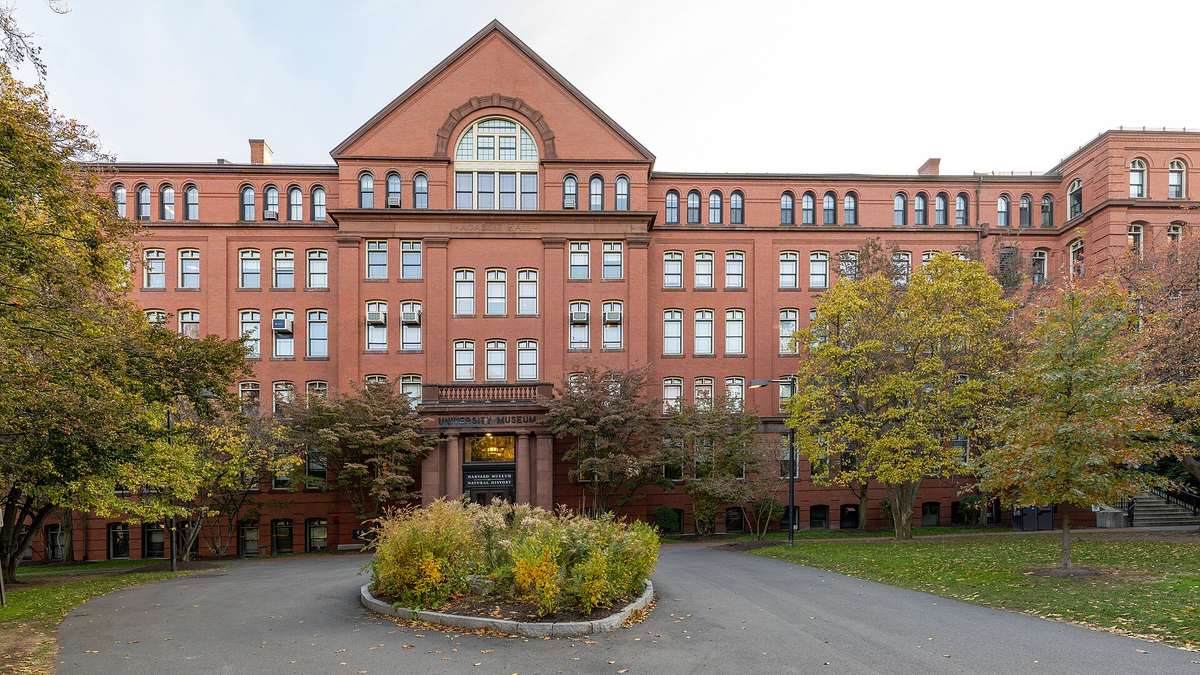
The Harvard Museum of Natural History sits in Cambridge, next door to Boston, on the Harvard University campus, with its main entrance at 26 Oxford Street. It is a large brick building; the museum puts it 8 to 10 minutes on foot from Harvard station on the MBTA Red Line. People come for the famous Glass Flowers, the whale skeletons in the Great Mammal Hall, minerals, meteorites and fossils. Adult admission is $20, and Massachusetts residents get in free at set hours.
History of the Harvard Museum of Natural History
The museum is young; its collections are old. According to hmnh.harvard.edu, the Harvard Museum of Natural History was set up in 1998 as the public face of three Harvard research museums: the Harvard University Herbaria, the Mineralogical & Geological Museum and the Museum of Comparative Zoology.
The mineral collection is the oldest of them. The Mineralogical & Geological Museum (mgmh.fas.harvard.edu) says it began in 1784 as a teaching collection for Professor Benjamin Waterhouse and is the oldest university mineral collection in the country. President George Washington visited it in 1789, his first year in office.
The Museum of Comparative Zoology was founded in 1859 by an act of the Commonwealth of Massachusetts; the Mineralogical & Geological Museum calls the naturalist Louis Agassiz its founder. The first unit of the University Museum building went up under his direction that same year. It later grew into a six-level, U-shaped building that held zoology, mineralogy, botany and anthropology under one roof. In 1901 his son, Alexander Agassiz, set up the Geological Museum in its southwest corner. The mineral and geological museums merged in 1977.
The research collections behind the galleries are huge. The museum gives more than 21 million specimens for the Museum of Comparative Zoology, more than five million for the Herbaria, more than 100,000 minerals and nearly 600 distinct meteorites. Visitors see a small share.
What to see
The galleries are on the third floor. The highlights:
- Glass Flowers. The Ware Collection of Blaschka Glass Models of Plants, made by Leopold and Rudolf Blaschka, a father and son team of Czech glass artists. From 1886 through 1936 they made 4,300 models of 780 plant species. The gallery was renovated in 2016, with the original 1890s cases rebuilt and new lighting and climate control. A newer Glass Flowers exhibition, The Blaschkas at the Microscope, shows their models of spore-forming plants and fungi.
- Sea Creatures in Glass. Glass marine animals by the same Blaschkas, made years before Harvard's commission.
- Great Mammal Hall. A two-story hall with a full-size giraffe and whale skeletons hanging from the ceiling. The balcony holds Birds of the World, hundreds of birds from over 200 families.
- Earth & Planetary Sciences. Thousands of rocks and minerals, gemstones, meteorites and a 1,600-pound amethyst geode.
- Romer Hall of Vertebrate Paleontology. Fossil fishes, dinosaurs and early mammals. Fossils from the Age of Mammals have their own Cenozoic Mammals gallery.
- Africa, Asia, Central and South America. Mounted animals: a hippopotamus, lion and gorilla in the Africa gallery (collected over a century ago), an Indian rhinoceros, Siberian and Bengal tigers, a jaguar and a wall of hummingbirds.
- Arthropods: Creatures That Rule. Insects and their relatives, some alive, plus a small display of beetles from David Rockefeller's collection.
- Climate Change, Evolution, New England Forests, Marine Life. Galleries on the climate, evolution research at Harvard, and the forests and coastal waters of New England.
The museum connects to the Peabody Museum of Archaeology & Ethnology, and a ticket to one gets you into both during regular hours. For more sights, see our list of places to visit in Boston.
How to get there
- Subway. Red Line to Harvard. The museum suggests walking through Harvard Yard and one block down Oxford Street; the building is on your right. The museum gives it as about 0.4 miles and 8 to 10 minutes. Harvard Yard is sometimes closed to the public; sidewalks run around it.
- Commuter Rail. Fitchburg Line to Porter; from there it is under a mile: Massachusetts Avenue toward Harvard Square, left on Everett Street, right on Oxford Street.
- MBTA buses. Several stop near the museum; plan the route on mbta.com.
- Bike. A Bluebikes dock is across the street from the entrance.
- Car. A few two-hour meters on Oxford and Kirkland Streets take quarters, cards or the parking app; street parking is free on Sundays. The closest university garage is 52 Oxford Street Garage, with day permits sold online in advance only, $13 to $25. The museum does not validate parking in Harvard Square garages.
The main entrance has 51 steps. An elevator is at the North Entrance on the left side of the building; you then pay at the museum shop on the third floor.
Hours and tickets
| Item | What the site says |
|---|---|
| Hours | daily 9:00 am-5:00 pm |
| Adults | $20.00 |
| Seniors (65+) | $18.00 |
| Non-Harvard students with ID | $15.00 |
| Youth 3-18 | $15.00 |
| Under 3 | free |
| Harvard ID holders | free, plus one guest |
| US veterans with a Veteran ID Card | $3 off |
Hours and prices checked November 11, 2026 on hmnh.harvard.edu.
Tickets are sold only at the admissions desk and the museum shop, not online. The museum closes on Thanksgiving and the day before, Christmas Eve, Christmas Day and New Year's Day, plus a few more days in late December, and a few times a year it opens late or closes early. The exact dates are on its Plan Your Visit page; check it before you go.
Free admission and tips
- Massachusetts residents get in free on Sundays 9:00 am-12:00 pm and Wednesdays 3:00-5:00 pm with proof of residency. Not for commercial groups.
- Massachusetts K-12 teachers get in free.
- EBT or WIC cardholders get in free with up to five guests.
- Active-duty military and their families get in free year-round through Blue Star Museums.
- Library passes from many Massachusetts libraries cover up to four people at a discount. Bring the physical pass; one person in the group must be a Massachusetts resident.
- Boston CityPASS includes the museum as one of its four picks.
- Gallery rules. Photos are fine without flash or tripods. No food or drink, and do not lean on the glass cases. Drawing is welcome, but no paints, pastels, chalk or clay.
- Light. Glass Flowers, Sea Creatures in Glass and Marine Life are kept dim to protect the objects.
- Access. Every gallery except the Birds of the World balcony is wheelchair accessible, and wheelchairs can be borrowed at the desk, first come, first served. Service dogs are welcome; emotional support animals are not.
For the wider city, see our Boston city page. The museum answers questions at 617-496-1638.
Questions people ask
Are the Harvard Glass Flowers really made of glass?
Yes. The Glass Flowers at the Harvard Museum of Natural History were made by Leopold and Rudolf Blaschka, a father and son team of Czech glass artists. From 1886 through 1936 they produced 4,300 glass models of 780 plant species. The gallery is included in regular admission, $20 for an adult.
Can I buy Harvard Museum of Natural History tickets online?
No. The museum sells tickets only at its admissions desk and in the museum shop. You can buy a Boston CityPASS online, which includes the museum, and show it at the desk. Regular admission is $20 for adults and $15 for ages 3 to 18; children under 3 are free.
When is the Harvard Museum of Natural History free?
Massachusetts residents get in free on Sunday mornings from 9:00 am to 12:00 pm and on Wednesdays from 3:00 to 5:00 pm with proof of residency. Admission is also free with an EBT or WIC card for up to five guests, and for active-duty military and their families through Blue Star Museums.
How far is the museum from Harvard station?
The museum puts it at about 0.4 miles, or 8 to 10 minutes on foot from Harvard station on the Red Line, through Harvard Yard and along Oxford Street. The main entrance is at 26 Oxford Street, Cambridge. When the Yard is closed, walk around it on the sidewalks.
Does the ticket include the Peabody Museum?
Yes. The Harvard Museum of Natural History is connected to the Peabody Museum of Archaeology & Ethnology, and admission to one admits you to both during regular hours. Both belong to the Harvard Museums of Science & Culture, whose four museums are within a five-minute walk of each other.
Places on the map
Sources
- Harvard Museum of Natural History
- Harvard Museum of Natural History: Plan your visit
- Harvard Museum of Natural History: Directions and parking
- Harvard Museum of Natural History: Accessibility
- Harvard Museum of Natural History: History
- Harvard Museum of Natural History: Exhibitions
- Harvard Museum of Natural History: Glass Flowers
- Mineralogical & Geological Museum at Harvard: History
- MBTA: Harvard station
- MBTA: Porter station