RussiansInUSA editorial team · Facts checked November 11, 2026
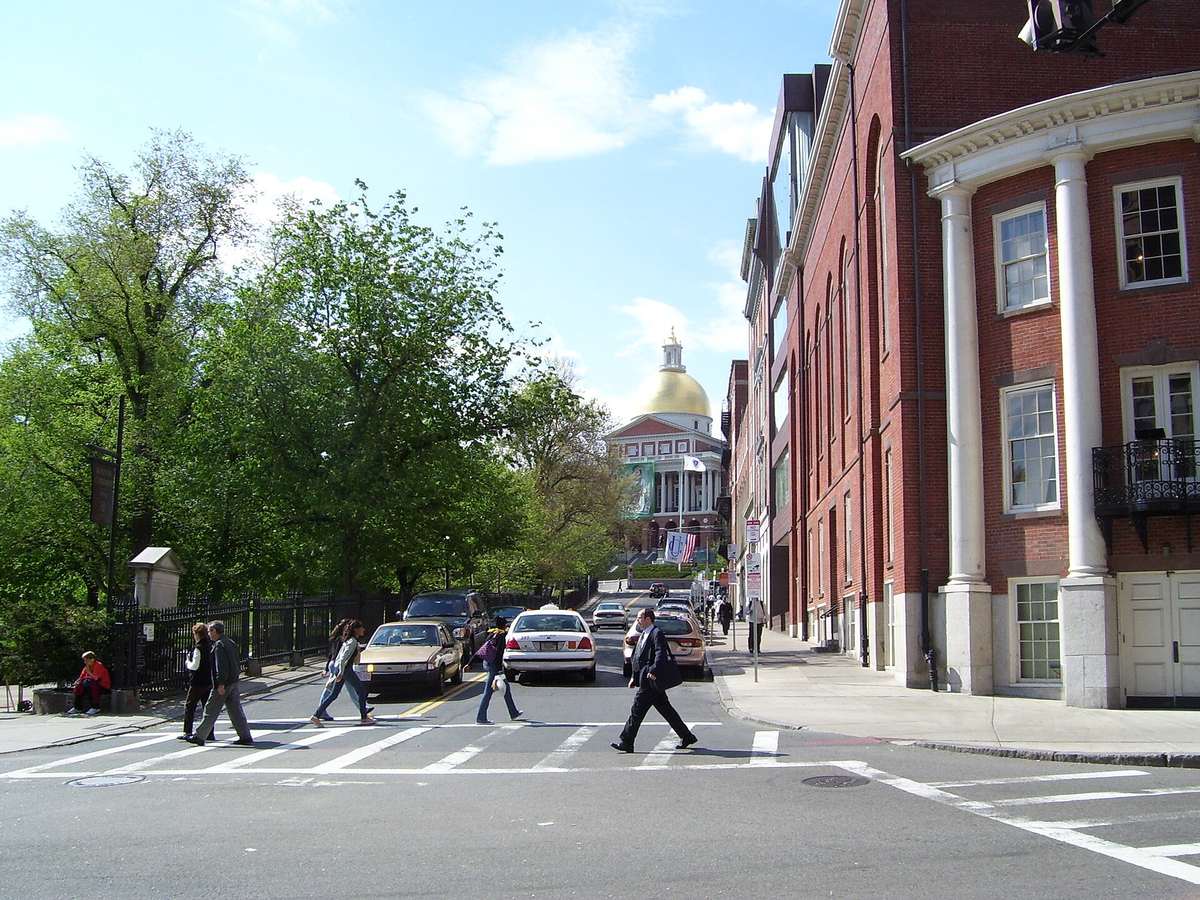
Beacon Hill in Boston is the old residential neighborhood on the hill above Boston Common, next to the Massachusetts State House. It has brick town houses from the late 1700s and 1800s, the State House's gold dome, and a north slope where a free African American community lived and where the Black Heritage Trail runs today. The neighborhood itself needs no ticket: these are city streets, open at any hour. The museums inside it, with hours and prices, are below. The Boston city page has the short version; this page goes further.
Beacon Hill history, year by year
According to the National Park Service, when European colonists settled Boston in the 1620s the area had three peaks, called Tri-mountain, Tremount or Sentry Hill. In 1635 settlers put a wooden signal light on the hill, and from then on the area was known as Beacon Hill.
In 1737 the merchant Thomas Hancock built the first house on the hill; it later passed to his nephew John Hancock. During the Siege of Boston in 1775 and 1776, British forces used the Hancock house as their headquarters, British commander General Gage took down the signal light, and a small fort was built on the hill. After the British left in March 1776, Bostonians put the signal light back. A storm blew it down in 1789. The Beacon Hill Eagle Memorial, designed by Charles Bulfinch, now stands in its place.
Real development started with the new State House, designed by Bulfinch and completed in 1798. Boston.gov says the Mount Vernon Proprietors, one of the earliest land development companies in the United States, formed around the same time. They bought 18 1/2 acres west of the State House, land the NPS says came from the painter John Singleton Copley, and built grand homes on the south slope facing the Common. Asher Benjamin, Solomon Willard and Alexander Parris designed Federal and Greek Revival houses, and apartment buildings followed later in the 19th century.
The north and west slopes were different: a working and middle-class community that included many free African Americans. Before the Civil War the area became a center of abolitionist and Underground Railroad activity. Parts of the three original peaks were cut away and used to fill land around the city.
The city created the Historic Beacon Hill District in 1955 and expanded it in 1958, 1963, 1975 and 2024. The Beacon Hill Architectural Commission reviews all exterior work visible from a public way, including views from the Common, the Public Garden, Storrow Drive, the Esplanade and the Longfellow Bridge. It meets on the third Thursday of each month.
What to see on Beacon Hill
Massachusetts State House
Bulfinch's 1798 building with the gold dome is still the seat of state government. Docents give free walking tours of about 45 minutes, starting in Doric Hall. Groups are advised to book ahead.
Beacon Hill Eagle Memorial
The Bulfinch-designed memorial stands where the signal light that named the hill used to be.
African Meeting House and the Black Heritage Trail
The African Meeting House at 8 Smith Court opened in 1806, built by a small but powerful free African American community. The NPS calls it the oldest surviving Black church structure in the nation. Frederick Douglass, Maria Stewart and William Lloyd Garrison spoke there, and the New England Anti-slavery Society and the New England Freedom Association met there. It was nicknamed the "Black Faneuil Hall." Today it is a National Historic Landmark managed by the Museum of African American History.
The museum's other building, the Abiel Smith School, was built in 1835 to educate African American children; the NPS says it is currently inaccessible. The Black Heritage Trail, about 1.5 miles long, links sites on the north slope. You can walk it on your own; the NPS offers self-guided audio tours of the area (Women of Beacon Hill, Underground Railroad in Boston) and the NPS App.
Boston Athenaeum
The Boston Athenaeum at 10 1/2 Beacon Street is a library and art museum on 12 floors. The first floor has rotating exhibitions and the Norma Jean Calderwood Gallery. The collection runs from rare first editions to current bestsellers, and the special collections of more than 200,000 rare items include George Washington's personal library. The fifth-floor terrace has city views and resident falcons.
How to get to Beacon Hill
Two MBTA stations serve the neighborhood. Charles/MGH, on the Red Line, is at Cambridge Street and Charles Street and has two elevators. Park Street, at Tremont Street and Winter Street by Boston Common, serves the Red Line and all Green Line branches (B, C, D, E). Neither station has parking. Check service alerts on mbta.com before you go; if the Green Line is disrupted, the Red Line also serves Park Street.
More of the city is in what to see in Boston.
Hours and tickets
| Place | Hours | Price |
|---|---|---|
| Neighborhood streets, Black Heritage Trail (self-guided) | any time | free |
| State House guided tour | 10:00 am to 3:30 pm, book at 617-727-3676 | free |
| Museum of African American History, general admission | Thursday to Sunday, 10 am to 4 pm, timed tickets at 10:30, 11:30, 1:30 or 2:30 | shown when you reserve on maah.org |
| Boston Athenaeum, first floor | Mon to Thu 9 am to 8 pm, Fri and Sat 9 am to 5 pm, closed Sunday | 14 and up $11, 13 and under with an adult $5, students, educators and military $8, Card to Culture $2 |
Hours and prices checked on November 11, 2026 at malegislature.gov, nps.gov, maah.org and bostonathenaeum.org. The legislature's page does not list tour days, so call before going. NPS ranger tours of the Black Heritage Trail ran Wednesday to Sunday at 10 am and 1 pm in the 2026 season, May 23 to September 27; outside it, plan a self-guided walk.
Tips before you go
- On Tuesdays and Wednesdays the Museum of African American History takes field trips, private tours and rentals only; general visitors come Thursday to Sunday. It is closed on Thanksgiving, Christmas and New Year's Day.
- The Athenaeum's one-hour Art & Architecture Tour (seven people or fewer) needs a ticket and often sells out days ahead.
- A $40 one-day Athenaeum membership opens all floors; a regular ticket covers the first floor only.
- The NPS says the African Meeting House and the Abiel Smith School are fully accessible to wheelchair users.
A half-day route: Park Street, the State House, the Black Heritage Trail on the north slope, then out to Charles/MGH.
Questions people ask
Does it cost anything to visit Beacon Hill?
No. Beacon Hill is a residential Boston neighborhood with public streets you can walk at any hour, and the Black Heritage Trail is free. You pay only for museums: Museum of African American History tickets are reserved on maah.org, and the Boston Athenaeum's first floor is $11 for ages 14 and up.
How do I tour the Massachusetts State House?
Docents give free guided tours of about 45 minutes between 10:00 am and 3:30 pm, starting in Doric Hall. Book through the State House Tours office at 617-727-3676; groups are advised to schedule in advance. Confirm the days on the same number.
Why is it called Beacon Hill?
According to the National Park Service, settlers put a wooden signal light on the summit in 1635. The British removed it during the Siege of Boston, Bostonians replaced it in 1776, and a storm blew it down in 1789. A memorial with an eagle designed by Charles Bulfinch now stands on the spot.
Which T station is closest to Beacon Hill?
Two MBTA stations serve it. Charles/MGH on the Red Line is at Cambridge Street and Charles Street. Park Street by Boston Common serves the Red Line and every Green Line branch. Neither has parking, so the T is the easier way to arrive.
Places on the map
Sources
- Beacon Hill, National Park Service
- Historic Beacon Hill District, City of Boston
- Boston African American National Historic Site, NPS
- Plan your visit, Boston African American NHS, NPS
- African Meeting House, NPS
- State House Tours, Massachusetts Legislature
- Museum of African American History
- Visit, Boston Athenaeum
- Charles/MGH station, MBTA
- Park Street station, MBTA
- Boston Campus, hours and tickets, Museum of African American History
- Accessibility, Boston African American NHS, NPS