RussiansInUSA editorial team · Facts checked November 11, 2026 · Official site
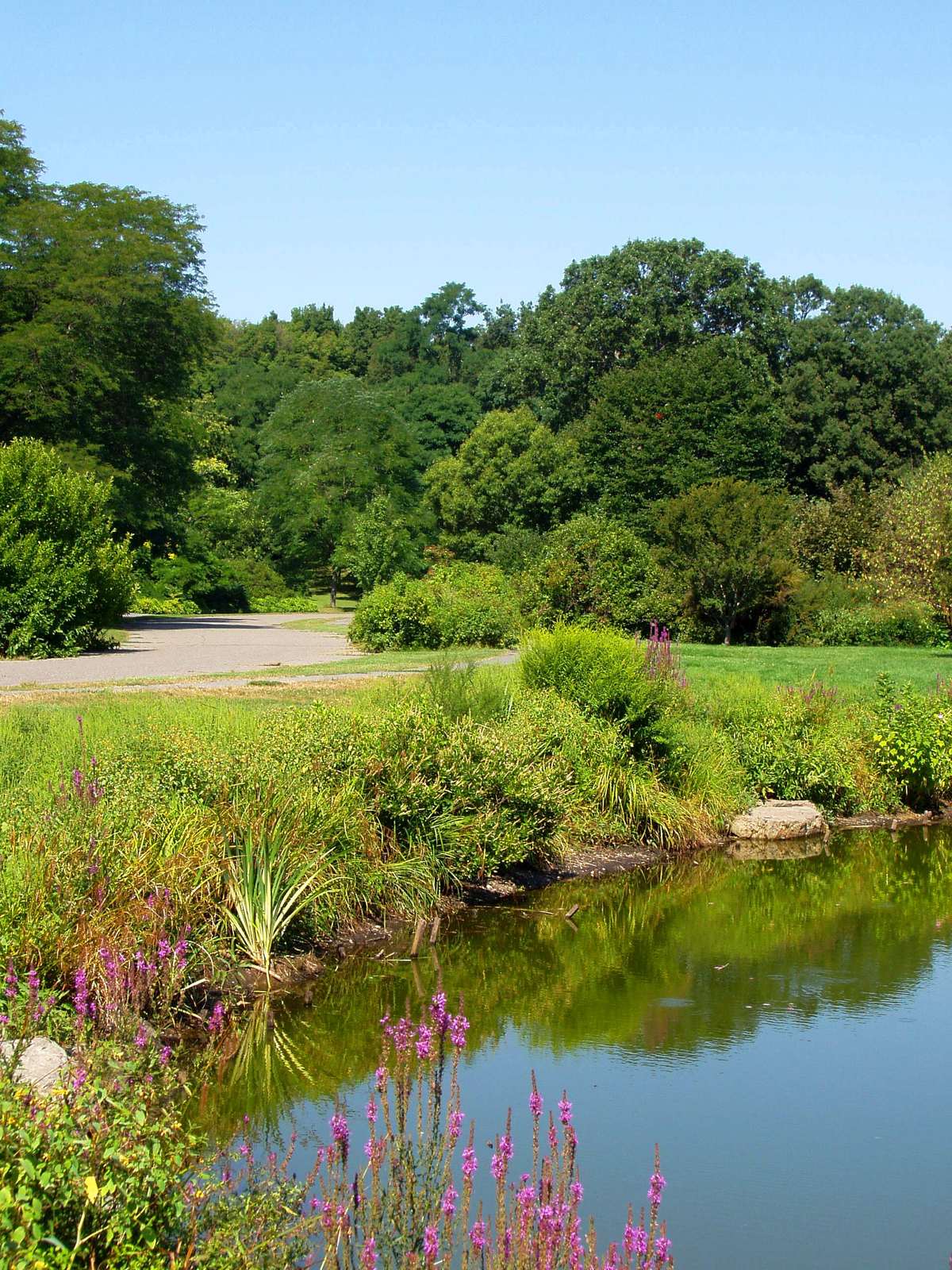
The Arnold Arboretum in Boston is Harvard University's 281-acre tree preserve in Jamaica Plain, with its main entrance at 125 Arborway. Admission is free and the grounds are open every day from sunrise to sunset. People come for the lilacs in May, centuries-old bonsai, trees from eastern Asia and the view of the city from Peters Hill. It is part of the Emerald Necklace park system, which our Boston city guide covers.
Arnold Arboretum history
Two bequests started it. In 1842 Benjamin Bussey left his land to Harvard College. In 1868 James Arnold, a New Bedford whaling merchant, left money in trust to create a public arboretum. Trustee George Barrell Emerson helped join the two gifts, and the Arboretum was founded in March 1872.
Its first director, Charles Sprague Sargent, led it for the next half-century. He laid out the grounds with Frederick Law Olmsted, the designer of the Emerald Necklace. According to the City of Boston, Olmsted designed the roads and the overall planting scheme, while Sargent collected the specimens and sited them by genus or family. In 1880 Olmsted wrote that on these acres "much the best arboretum in the world can be formed."
Harvard gave the land to the City of Boston and leased it back for $1 a year on a 1,000-year lease, with the option of one renewal. That split still holds: the city owns the land and maintains the infrastructure, and Harvard curates the collections and maintains the grounds.
| Year | Event |
|---|---|
| 1880 | The US government commissions Sargent to take a census of American trees |
| 1892 | Sargent visits Japan, starting three decades of collecting trips to China, Japan and Korea |
| 1908 | First Lilac Sunday |
| 1937 | Isabel Anderson donates most of the Larz Anderson collection of Japanese dwarfed trees |
| 1962 | The Dana Greenhouses are built |
| 1980 | Sino-American Botanical Expedition to China |
| 2011 | The Weld Hill Research Building opens |
| 2022 | 150th anniversary |
Harvard puts the living collection at some 16,000 plants (the city says about 15,000), each one scientifically documented, with an emphasis on the floras of eastern North America and eastern Asia.
What to see at the Arnold Arboretum
Lilac Collection. 406 lilac plants in 172 kinds, including 132 cultivars. Bloom lasts about five weeks each spring, and in mid-May thousands of visitors come to see it. The oldest lilac, a Japanese tree lilac, arrived in 1876. Lilac Sunday has been held every year since 1908.
Bonsai and Penjing Collection. It began with the Japanese trees Larz Anderson brought to the US in 1913 after serving as ambassador to Japan. Its core is five Hinoki cypresses between 150 and 275 years old. The pavilion is open mid-April to mid-November, daily 8:00 am to 3:30 pm, except holidays.
Explorers Garden. Nearly five acres just below the summit of Bussey Hill, testing ground for plants from E. H. Wilson's early 1900s expeditions: seven son flower, paperbark maple, dove tree, and two of the largest Franklin trees in the world, a species extinct in the wild.
More collections. The maple collection, the conifers, Hemlock Hill, Rhododendron Dell, the crabapples, the Leventritt Shrub and Vine Garden and Bussey Brook Meadow.
Peters Hill. At the south end. The city says its summit offers one of the best vistas in Boston.
How to get there
By subway: take the MBTA Orange Line to Forest Hills and leave through the door marked "Arnold Arboretum." The Washington Street Gate is directly across Washington Street from the station and leads through Bussey Brook Meadow. The Forest Hills Gate is a short walk up the Arborway; bear right at the pond for the Visitor Center.
Forest Hills is also an MBTA hub for the Commuter Rail (including the Needham Line) and many bus routes, such as the 39 from Back Bay Station. Check schedules on mbta.com.
The Visitor Center is in the Hunnewell Building at 125 Arborway, and the Arborway Gate is the closest gate to it.
By car: there is no visitor parking inside. Street parking nearby is free. On the Arborway, park before the Forest Hills Gate or after the Arborway Gate; six accessible spaces sit on either side of the Arborway Gate. Near Peters Hill, use Flora Way and Walter Street, off the sidewalk. The Arborway fills up in spring and during lectures, so allow extra time.
Hours and tickets
| What | Hours | Price |
|---|---|---|
| Grounds | daily, sunrise to sunset | free |
| Visitor Center (Hunnewell Building) | daily, 10:00 am to 4:00 pm | free |
| Bonsai pavilion | mid-April to mid-November, daily 8:00 am to 3:30 pm, except holidays | free |
Hours and prices checked November 11, 2026 on arboretum.harvard.edu. Visitor Center phone: 617-384-5454.
Rules and tips
Dogs must stay leashed and owners must pick up after them. Bikes and e-bikes may use only paved paths and the Blackwell Footpath, at 10 mph or less. Picnics, fires and barbecues are prohibited, as are climbing trees, hanging hammocks, walking in plant beds and picking plants. Recreational drones are banned to protect wildlife. No smoking.
Restrooms in the Hunnewell Building are open 10:00 am to 4:00 pm; portable restrooms stand year-round near the Arborway Gate, on Hemlock Hill Road and at the base of Peters Hill.
For ticks, stay on trails, wear long clothing, use DEET or permethrin and check yourself afterward. Seek shelter in high winds or lightning. For more sights, see places to visit in Boston.
Questions people ask
Is the Arnold Arboretum free?
Yes. The Arnold Arboretum is free every day and needs no tickets. The grounds are open from sunrise to sunset, and the Visitor Center in the Hunnewell Building at 125 Arborway is open daily from 10:00 am to 4:00 pm. The bonsai pavilion is also free and opens from mid-April to mid-November.
When do the lilacs bloom at the Arnold Arboretum?
The collection of 406 lilac plants blooms for about five weeks each spring, and thousands of visitors come in mid-May. Lilac Sunday is an annual celebration held since 1908; check the Arboretum's site for the date. Arborway parking fills up in spring, so the Orange Line to Forest Hills is easier.
Can I bring my dog?
Yes, on a leash at all times, and owners must pick up after their dogs. The same Arboretum rules ban picnics, fires, barbecues, drones and climbing trees. Bikes and e-bikes are allowed only on paved paths and the Blackwell Footpath, at 10 mph or less.
Who owns the Arnold Arboretum?
The City of Boston owns the land and maintains the infrastructure. Harvard University leases it for 1,000 years at $1 a year, curates the plant collections and maintains the grounds. The Arboretum was founded in March 1872 and is part of Olmsted's Emerald Necklace park system.
Places on the map
Sources
- Arnold Arboretum of Harvard University
- Arnold Arboretum: Visit
- Arnold Arboretum: Getting here
- Arnold Arboretum: Visitor tips and guidelines
- Arnold Arboretum: About us
- Arnold Arboretum: Our history
- Arnold Arboretum: Plants
- Arnold Arboretum: Lilac Collection
- Arnold Arboretum: Bonsai and Penjing Collection
- Arnold Arboretum: Explorers Garden
- City of Boston: Arnold Arboretum
- MBTA: Forest Hills station
- Arnold Arboretum: Collections
- MBTA: Route 39 Forest Hills - Back Bay
- MBTA: Needham Line