Car Insurance Without US Driving History: State Minimums, Price and Foreign Records
RussiansInUSA editorial team · Updated November 5, 2026 · Facts checked October 28, 2026
You can buy car insurance without a US driving history: state law requires the owner to carry a policy, not to have years of American driving behind them. Expect to pay more at first, because the insurer cannot see your record or any prior US policy. Each state sets the minimum: 25/50/10 plus no-fault in New York, 30/60/15 in California, 30/60/25 in Texas. Below is what those numbers mean, why the price is higher, whether a record from Russia or Ukraine can help, and how to buy from a licensed seller.
Car insurance in the US is regulated by each state
Each state decides which coverage is mandatory and supervises insurers through its own insurance department (in New York, the Department of Financial Services, DFS). Advice from a friend in another state may not apply to you.
States check. New York insurers report policies to the DMV, which tracks coverage on every registered vehicle; going uninsured can cost you your registration and license plus penalties. Illinois verifies each vehicle's policy electronically at least twice a year, fines uninsured drivers at least $500, suspends plates and charges a $100 reinstatement fee. In Pennsylvania a lapse can mean a suspended registration. Florida requires insurance before you register a car and for the whole registration period.
So buy the policy before you drive the car away, not after. Our guide to buying a car as a newcomer covers the purchase itself.
Minimum car insurance by state
"25/50/10" means up to $25,000 for injuries to one person, $50,000 for everyone hurt in one accident, and $10,000 for damage to other people's property. This is what the insurer pays others when you are at fault.
| State | Injury: per person / per accident | Property damage | Also required |
|---|---|---|---|
| New York | $25,000 / $50,000 ($50,000 / $100,000 for death) | $10,000 | no-fault (PIP) up to $50,000 per person; uninsured motorist |
| California | $30,000 / $60,000 | $15,000 | none |
| Florida | FLHSMV requires only PIP and PDL to register | $10,000 (PDL) | PIP of at least $10,000 |
| Illinois | $25,000 / $50,000 | $20,000 | uninsured motorist $25,000 / $50,000 |
| Pennsylvania | $15,000 / $30,000 | $5,000 | medical benefits $5,000 |
| Texas | $30,000 / $60,000 | $25,000 | PIP is in every policy unless rejected in writing; insurers must offer uninsured motorist |
Minimums checked October 28, 2026 on the sites of New York DFS, the California Department of Insurance, FLHSMV, the Illinois Department of Insurance, the Pennsylvania Insurance Department and the Texas Department of Insurance.
The Illinois Department of Insurance warns that state minimums may not be enough to protect you from a lawsuit. If an accident costs more than your limit, you can be sued for the rest, which is why many drivers buy higher limits.
What liability, collision and comprehensive cover
The main coverages, as the National Association of Insurance Commissioners (NAIC) and New York DFS describe them:
- Bodily injury liability pays people you injure in an accident you caused: medical bills, lost wages, pain and suffering.
- Property damage liability pays for the other car, fence or wall you damage.
- Uninsured motorist pays you if you are injured by a driver with no insurance or a hit-and-run driver. It is mandatory in New York, where it covers injuries but not the car.
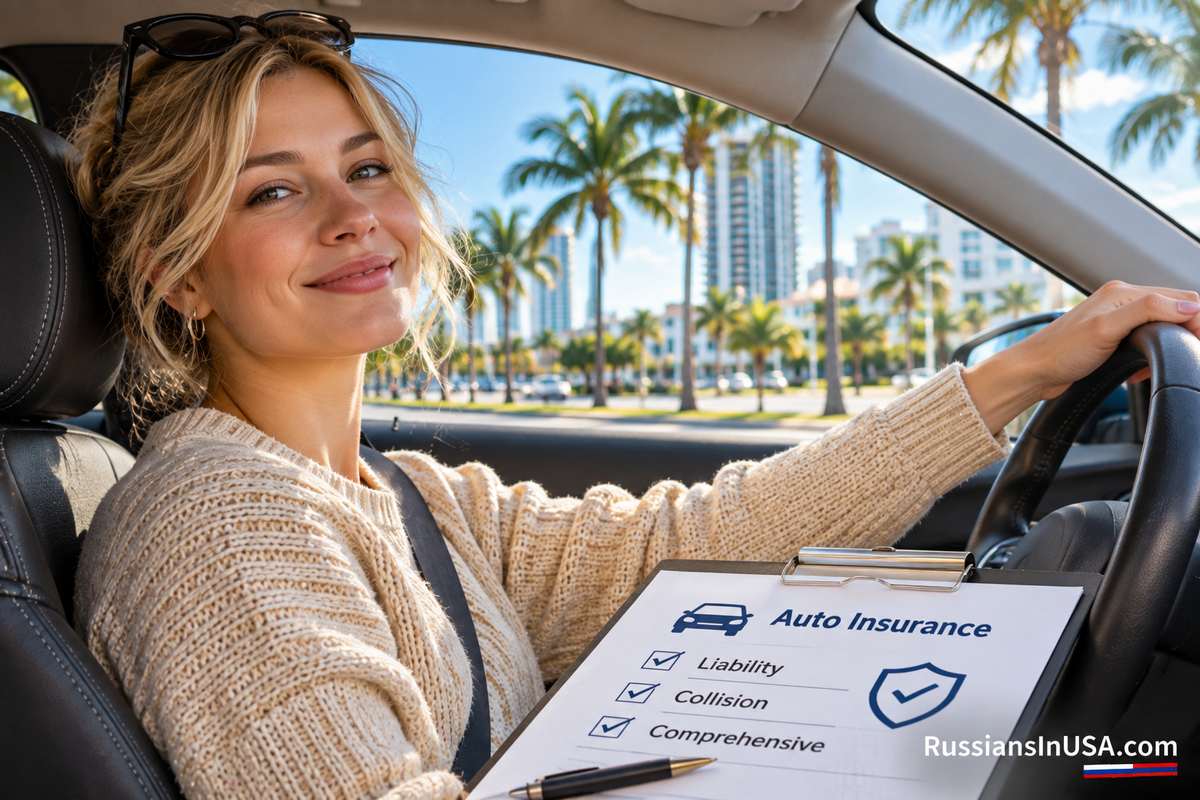
- Collision repairs your own car after it hits a vehicle or object. Optional by law, but a lender or lessor may require it.
- Comprehensive covers almost everything else: fire, storms, vandalism, floods, theft, broken glass.
- PIP or no-fault in New York, per DFS, pays the driver, passengers and injured pedestrians for medical costs and lost earnings whoever caused the crash, with basic coverage up to $50,000 per person.
Why insurance costs more without a US driving history
The NAIC lists the factors insurers use: driving record, where you live, age, marital status, mileage, make and model, and prior insurance, including past cancellations for nonpayment. The Illinois and Texas insurance departments add that many or some companies also use credit information.
A newcomer loses on several at once: no US driving record, no prior US policy, often no credit file. To the insurer that is an unknown risk, and it prices it in.
California makes this visible. Insurers must offer a Good Driver rate to drivers licensed at least three consecutive years with no more than one point, and that rate must be at least 20% below the company's regular rate. Without three years, you are not in that group.
What helps over time: a clean record, continuous coverage with no gaps, and credit history where your state lets insurers use it. Deadlines for getting a state license are in our driver's license guide.
Will an insurer count a foreign driving record?
There is no single rule. Each company sets its own underwriting rules. One company's filing shows it can happen: State Farm's California underwriting guidelines (for decisions made from August 15, 2020), filed in a California Department of Insurance proceeding, let a driver with less than three years of US or Canadian licensing count foreign experience toward 36 months to meet the Good Driver licensing requirement. With at least 18 months of US licensing, a self-certification of up to 18 months abroad was enough; with less, the driver needed a foreign motor vehicle record and proof of how long they had been licensed. These are one company's 2020 rules and may have changed.
We found no official rule that requires insurers to accept foreign experience. In practice: ask every agent whether the company counts it and what proof it wants, keep a driving record from your home country's traffic police with an English translation, and do not stop at the first refusal.
Where to buy and how to check the agent
Get several quotes. New York DFS says rates vary considerably, and warns against choosing on price alone without looking at how the company handles claims. The NAIC says to give every agent the same information so quotes are comparable, and to ask about discounts for multiple cars, anti-theft devices and low mileage.
Check the license before you sign an application. The NAIC says to confirm with your state insurance department that the company and agent are licensed; with an unlicensed insurer there is no guarantee your claim will be paid. DFS adds that having a website does not make an insurer licensed. In California use the department's License Status Inquiry or call 1-800-927-4357; Illinois points to the NAIC State Based Systems license lookup; in New York ask the agent or broker for their New York license number.
If everyone turns you down, states run plans for drivers the regular market will not cover. New York has the New York Automobile Insurance Plan, (212) 943-5100, where the premium is the same whichever agent submits it. Illinois has the Illinois Auto Insurance Plan for drivers turned down elsewhere who hold or qualify for a license, owe no unpaid premium from the last 36 months and have a safe car. California has a low-cost program for drivers with income at or below 250% of the federal poverty level, a car worth $25,000 or less and a California license: 1-866-602-8861.
False answers and fraud
DFS says to answer driving history and vehicle questions fully and accurately. An insurer that finds fraud or a material misstatement in the application can cancel the policy mid-term. In New York, fraud in a claim can lead to criminal prosecution and a civil penalty of up to $5,000 plus the value of the claim.
A common newcomer trap is putting the car under an experienced relative's name when you will be the one driving it. An insurer may treat a wrong owner or main driver as a material misstatement. Also be wary of an agent who deliberately quotes a low Auto Plan premium to win your business; DFS asks people to report such agents to the Auto Plan and the department. If you buy online, DFS says to make sure the site is secure.
What to do after an accident
The Texas Department of Insurance gives steps that work anywhere:
- If no one is hurt, move out of the road. If someone is hurt or the other driver left, call the police and get a copy of the police report for your insurer.
- Photograph the other driver's license and insurance, or write down their name, phone, insurer and policy number.
- Photograph the cars, plates, damage, street signs and the intersection. Get witnesses' names and numbers.
- Write down the place, time, weather and what happened.
- Report the accident to your insurer and write down the adjuster's name and phone number.
In Texas an insurer cannot require you to use a shop on its list, and in New York you have the right to choose the shop. In New York written notice of a no-fault claim is generally due within 30 days of the accident, so report injuries right away. Russian-speaking shops are in our auto repair directory.
Questions people ask
Can I insure a car with a Russian driver's license?
It depends on the state and the insurer, since each company decides whom it covers and at what price. Foreign experience can count: one company's filing, State Farm's 2020 California guidelines, let a foreign driving record fill the gap to 36 months. Ask the agent which records their company accepts before you apply.
What is the minimum car insurance in New York?
New York DFS lists 25/50/10: $25,000 for injury to one person, $50,000 per accident, $10,000 for property damage, and $50,000 and $100,000 for death. New York also requires no-fault coverage of up to $50,000 per person and uninsured motorist coverage.
Why is car insurance more expensive for new immigrants?
Insurers price risk using driving record, prior insurance, location, the car and, in states such as Texas and Illinois, credit information. A newcomer has no US driving record and no prior US policy, so the risk is unknown to the company. In California the Good Driver rate requires three years licensed.
What if no insurance company will sell me a policy?
Ask about your state's plan for drivers the regular market turns down. New York has the New York Automobile Insurance Plan at (212) 943-5100. Illinois has the Illinois Auto Insurance Plan for drivers refused by other insurers. California runs a low-cost auto program for income-eligible drivers.
Sources
- New York DFS: Auto Insurance
- NAIC: Auto Insurance consumer guide
- NAIC: State insurance departments
- California Department of Insurance: Automobile Insurance Guide
- California Department of Insurance: State Farm class plan proceeding PA-2018-00004, filing that includes State Farm's Private Passenger Auto Underwriting Eligibility Guidelines (2020)
- FLHSMV: Insurance requirements
- Illinois Department of Insurance: Auto Insurance Shopping Guide
- Illinois Secretary of State: Mandatory Insurance
- Pennsylvania Insurance Department: Auto Insurance
- Texas Department of Insurance: Auto insurance guide
- Texas Department of Insurance: What to do after a wreck