RussiansInUSA editorial team · Facts checked November 5, 2026 · Official site
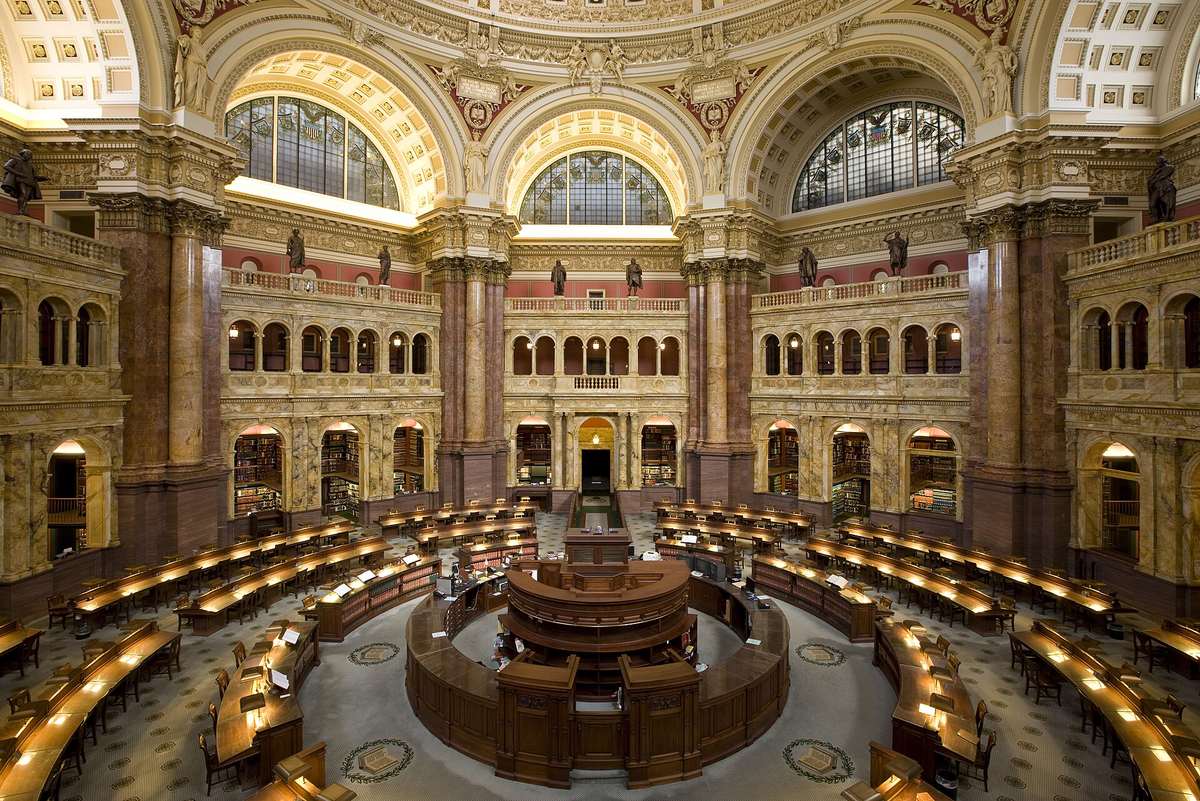
The Library of Congress in Washington DC fills three buildings on Capitol Hill, and visitors head for the main one, the Thomas Jefferson Building at 10 First Street SE, across the street from the Capitol. Entry is free with a free timed pass. The Library calls itself the largest library in the world and the main research arm of Congress. People come for the Great Hall, the Gutenberg Bible and the view into the Main Reading Room; some stay to read.
History of the Library of Congress
The Library began in 1800, when President John Adams approved $5,000 for books for Congress. Its first collection, 740 books and 3 maps according to the Library's visitor guide, was kept in the new Capitol. British troops burned the Capitol in 1814 and the library with it.
Thomas Jefferson, retired at Monticello, offered his own library as a replacement. In 1815 Congress paid $23,950 for his 6,487 books. After two disastrous fires and with space running out, Congress approved a separate building; Ainsworth Rand Spofford, Librarian of Congress from 1864 to 1897, had pushed for one.
John L. Smithmeyer and Paul J. Pelz designed it in what was then called the Italian Renaissance style. The Architect of the Capitol (aoc.gov) now describes it as a premier example of Beaux Arts. From 1888 Brigadier General Thomas Lincoln Casey and Bernard R. Green ran construction, and from 1892 the general's son, Edward Pearce Casey, supervised the decoration. More than forty American painters and sculptors worked on it, and it was the first public building in Washington built with electricity installed.
The building opened on November 1, 1897, as the largest library in the world at the time. Its copper dome was gold-leafed until the 1930s. It was named for Jefferson in 1980, the year the James Madison Memorial Building opened. The third building is named for John Adams.
What to see in the Jefferson Building
The Great Hall's stained-glass ceiling is 75 feet above the marble floor. A brass compass rose set in the floor is ringed by the twelve signs of the zodiac. On the staircase railings, small children carry the tools of different trades; look on the north side for a gardener, an entomologist and an electrician.
Through the Commemorative Arch is the Gutenberg Bible, printed in Mainz in the mid-1450s, the first book printed with movable metal type in Western Europe. Nearby, by the elevators, five paintings by Elihu Vedder show good and bad government and their results.
On the second floor a staircase leads to the gallery overlooking the Main Reading Room. At its foot is Vedder's glass and gold-leaf mosaic of Minerva, holding a scroll that lists fields of study. Inside the reading room, Edwin Blashfield's mural floats 125 feet above the floor. Bronze statues on the balustrades include Moses, Columbus, Beethoven, Michelangelo, Shakespeare and Newton, above 236 researchers' desks. The mezzanine windows look out on the Capitol.
To step into the reading room itself, join a walkthrough of about 5 minutes around the center desk: Tuesday to Friday, 10:30 to 11:30 am and 2 to 3 pm, plus Thursday 5 to 7 pm. Free tickets are handed out in the Great Hall, first come, first served, 10 minutes before each session; school groups are not permitted. As of November 5, 2026, the Visit the Library page says the Library is not offering guided tours; check loc.gov/visit before you go. Roaming volunteers in the Jefferson Building answer questions and give directions.
Reading rooms and the Reader Identification Card
Books are not checked out; they are used only on the premises. To use the reading rooms you need a Reader Identification Card, open to anyone 16 or older with a valid government-issued photo ID such as a driver's license, state ID or passport. Researchers aged 16 and 17 also bring a permission form signed by a parent or guardian.
- Fill in the online pre-registration form before you go.
- Leave coats and bags in a cloak room.
- Take your physical ID to a Reader Registration Station in the Jefferson Building (rooms LJ 110 and LJ 139) or the Madison Building (LM 133). Digital IDs are not accepted.
- Staff take your photo and issue the card, valid for two years.
Registration by mail, email or phone is not possible, and researchers need no timed pass. Research centers are open Monday to Friday, 8:30 am to 5 pm, with evening and Saturday hours that vary by room.
For readers from the former Soviet Union, the European Reading Room, LJ 249 on the second floor of the Jefferson Building, is the place to start. Its multilingual reference specialists keep current Slavic and Baltic periodicals and newspapers, plus newspapers on microfilm. Collections it features include the Prokudin-Gorskii photographs, Meeting of Frontiers and the Anatoliy Rubinov papers, letters to the editor of Literaturnaia Gazeta from 1968 to 1996. It is open Monday to Friday, 8:30 am to 5 pm; phone (202) 707-4515.
How to get to the Library of Congress
The closest Metro stop is Capitol South on the Orange, Blue and Silver lines. Leave by the main exit and walk about two blocks north on First Street SE. Trains there run toward Ashburn, Vienna, Franconia-Springfield, Largo and New Carrollton; schedules are on wmata.com. Union Station on the Red Line is half a mile away.
Street parking is limited to two-hour zones and meters, and the closest public lot is at Union Station. Commercial buses are restricted on Capitol grounds. Reagan National Airport (DCA), the closest, is 4.4 miles away. The accessible entrance to the Jefferson Building is on First Street.
Hours and tickets
| What | When and how |
|---|---|
| Jefferson Building, Tuesday, Wednesday, Friday, Saturday | 10 am to 5 pm |
| Jefferson Building, Thursday | 10 am to 8 pm |
| Sunday, Monday, select federal holidays | closed |
| Last entry | 30 minutes before closing |
| Entry | free, with a timed pass |
| Booking | up to 20 passes per person, up to 30 days ahead |
| Same-day passes | online daily at 9 am Eastern |
| Groups of 21 or more | group form, up to 60 days ahead |
| Research centers | Monday to Friday, 8:30 am to 5 pm |
Hours and prices checked November 5, 2026 on loc.gov.
Live! at the Library runs Thursdays from 5 to 8 pm; it needs a timed pass too, and some programs need a separate event ticket. Passes are on the Visit the Library page.
Security rules and tips
Everyone goes through a metal detector and an x-ray check run by the U.S. Capitol Police, and bags are opened on the way out. Not allowed: bags larger than 18 x 14 x 8.5 inches, aerosols, knives and sharp objects, drones, balloons, sealed envelopes and packages. Food and drinks in original packaging and creams up to 3.4 oz are fine.
Security lines are longest from March through July. Formal photography, such as posed portrait, wedding or other photo sessions, needs a permit approved in advance. The Library Store is on the first floor. For ADA accommodations, write to ADA@loc.gov at least five days ahead.
The Capitol and the National Mall are next door; see places to visit in Washington and the Washington DC city guide.
Questions people ask
Do you need a ticket for the Library of Congress?
Yes. The Thomas Jefferson Building requires a free timed pass, booked on loc.gov up to 30 days ahead, up to 20 per person. Same-day passes are released online at 9 am Eastern. Researchers going straight to a reading room do not need a timed pass.
Can you borrow books from the Library of Congress?
No. Books are used only on the premises, in the reading rooms. You need a Reader Identification Card, issued to anyone 16 or older who shows a physical government-issued photo ID such as a passport. The card is valid for two years, and you pre-register online.
How do you see the Main Reading Room?
You can look down on it from the second-floor gallery. To enter, join the five-minute walkthrough, Tuesday to Friday from 10:30 to 11:30 am and 2 to 3 pm, plus Thursday 5 to 7 pm. Free tickets are handed out in the Great Hall 10 minutes before each session.
Where are the Slavic and Eastern European materials?
Start in the European Reading Room, room LJ 249 in the Jefferson Building. It holds current Slavic and Baltic periodicals and newspapers, newspapers on microfilm, and features the Prokudin-Gorskii photographs. It is open Monday to Friday, 8:30 am to 5 pm, and you need a Reader Identification Card.
Places on the map
Sources
- Library of Congress
- Library of Congress: Visit the Library (hours, timed passes, walkthroughs)
- Library of Congress: Directions
- Library of Congress: History of the Library
- Library of Congress: About the Library
- Library of Congress: Frequently Asked Questions
- Library of Congress: Thomas Jefferson Building Quick Guide (PDF)
- Library of Congress: Get Your Library Card
- Library of Congress: Building Access
- Library of Congress: User Policies (prohibited items)
- Library of Congress: European Reading Room
- Architect of the Capitol: Thomas Jefferson Building
- WMATA: Capitol South station