RussiansInUSA editorial team · Facts checked November 5, 2026 · Official site
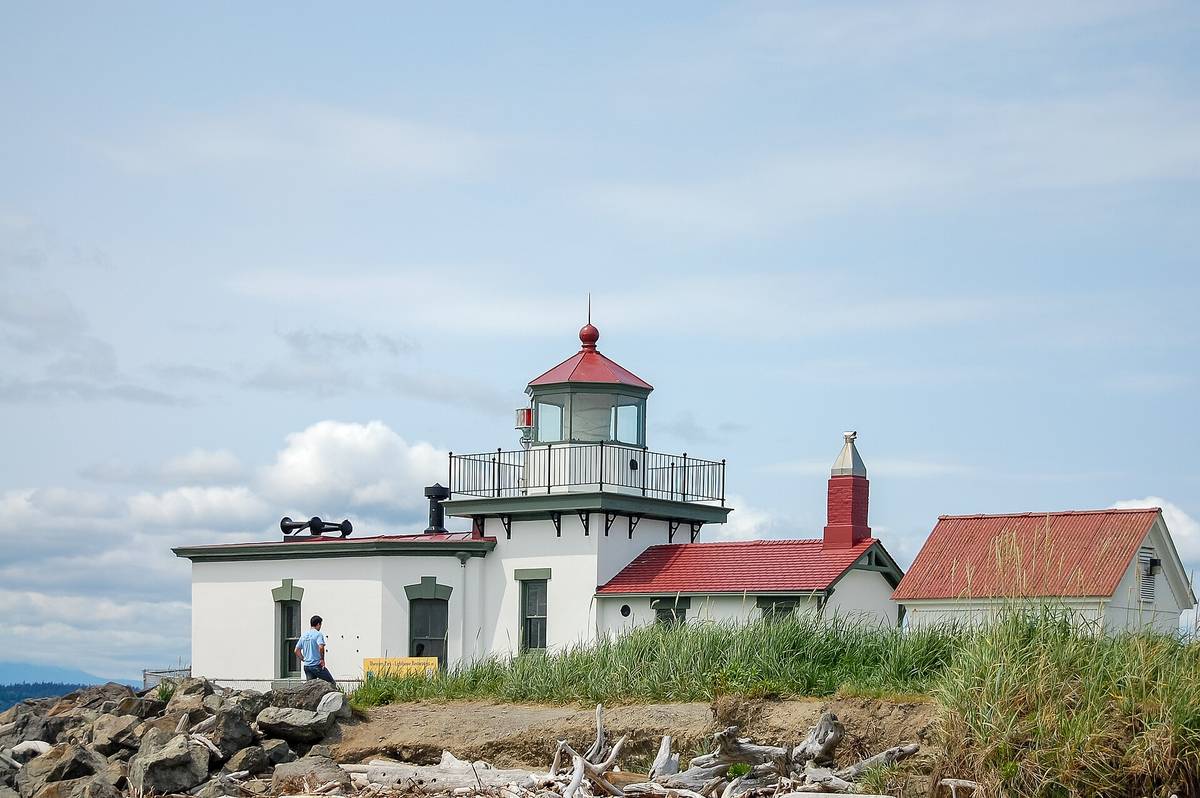
Discovery Park is Seattle's largest park: 560 acres of natural area on Magnolia Bluff above Puget Sound, at 3801 Discovery Park Blvd. in the Magnolia neighborhood. It covers most of the former Fort Lawton army post and is open daily from 4:30 a.m. to 11 p.m. People come for forest trails, meadows, sea cliffs, two miles of protected tidal beaches below the bluff and the West Point Lighthouse, with views of both the Cascade and Olympic ranges.
This page goes deeper than the short entry in our Seattle city guide; the city's other sights are on what to see in Seattle.
History: from Fort Lawton to Discovery Park
According to Seattle Parks, ancestors of the Duwamish and other Coast Salish nations used this site for at least 4,000 years. The 1855 Treaty of Point Elliott forced Native people onto reservations.
The bluff got its name in 1857, when Lt. George Davidson of the U.S. Coast Survey mistook its red-barked madrona trees for magnolias, as Seattle's historic preservation office tells it. In 1853 Henry Smith had staked a 160-acre claim at the south end of the bluff. In 1872 the U.S. Lighthouse Board recommended a light at West Point, and the lighthouse was built in 1881.
In 1896 the Secretary of War picked the bluff for an artillery battery to defend Seattle and the south Sound from naval attack. Local citizens and governments gave the Army 703 acres in the late 1890s, and in February 1900 the post was named Fort Lawton after Major General Henry Ware Lawton, who had died in the Philippines the year before. It became an infantry post in 1902, and in 1910 the designer John C. Olmsted drew a new master plan for it. In World War II the fort was a staging center and a prisoner of war camp; in the 1950s it held anti-aircraft missiles and radar.
The Army offered the fort to Seattle as a park for one dollar in 1938, and the City Council said no. In 1965 Congressman Brock Adams introduced a bill to return surplus land to the city, and in 1968 voters approved a bond with $3 million to buy it. On March 8, 1970, Bernie Whitebear and Bob Satiacum led a nonviolent occupation of the fort. It ended peacefully about four months later with a 99-year lease on 20 acres for a cultural center, granted to the group now called United Indians of All Tribes.
The federal government transferred 391 acres to the city in September 1972. In 1973 Senator Henry Jackson dedicated Discovery Park, named for HMS Discovery and Captain George Vancouver's 1792 exploration of Puget Sound. In 1974 the city decided to keep most of the park as open space and nature reserves, and voters turned down an 18-hole golf course in 1975 by about two to one. The Daybreak Star cultural center opened in 1977, the same year the lighthouse joined the National Register of Historic Places. The light was automated in 1985, and in 1988 the best-preserved fort buildings became the Fort Lawton Landmark District.
What to see in Discovery Park
- West Point Lighthouse (1881): one of 18 active lighthouses in Washington, per Seattle Parks, visible from the South Beach Trail, which Friends of Discovery Park call the most popular route to it.
- The beaches: two miles of protected tidal beach, plus meadows, sea cliffs, active dunes, thickets and streams.
- Daybreak Star: the Native cultural center near the North Lot.
- Fort Lawton Landmark District: the old army buildings.
- Facilities: a play area, basketball and tennis courts, drinking fountains and restrooms.
Discovery Park trails
The city points visitors to the trail map of Friends of Discovery Park. Its figures:
| Trail | Length | Elevation gain | Note |
|---|---|---|---|
| Loop Trail | 2.8 miles | 220 ft | 1 to 1.5 hours, no stairs |
| South Beach Trail | 0.7 miles | 280 ft | most popular way to the lighthouse, five staircases |
| North Beach Trail | 1.2 miles | 190 ft | steepest upper section, three sets of stairs |
| Hidden Valley Trail | 0.8 miles | 190 ft | dense forest, long staircase |
| Wolf Tree Nature Trail | 0.25 miles | 50 ft | no dogs |
The Loop Trail runs through forest and grassland, with views of Puget Sound and the Olympic Mountains from the south bluff, and is the starting point for the other trails. The Loop, North Beach and South Beach trails together make about 4.5 miles. At low tide you can walk the beach from North Beach to the lighthouse and on to South Beach. In winter some sections get muddy.
How to get to Discovery Park
Bus. King County Metro routes 33 and 24 run from downtown Seattle (3rd Ave & Pike St) through Seattle Center and Magnolia, seven days a week. Route 33 enters the park at its northeast corner and serves the North Lot near Daybreak Star, ending at Illinois Ave & Texas Way. Route 24 stops on the park's southern edge; its nearest timepoint is W Emerson St & Magnolia Blvd W. Schedules are on King County Metro.
Car. The general lots are the North Lot (Illinois Ave & Texas Way), the East Lot (Discovery Park Blvd & 36th Ave W) and the South Lot (43rd Ave W & W Emerson St). There is no general parking on Discovery Park Blvd past the East Lot. The Beach Lot is for ADA placard holders only, and beach parking permits are not issued while the visitor center is closed; parking there without one can mean a citation or a tow.
Boat. Boats may land only on the 100 feet of shoreline north and 100 feet south of the lighthouse.
Hours, entry and the visitor center
| Item | Status |
|---|---|
| Park hours | daily, 4:30 a.m. to 11 p.m. |
| Entry fee | none listed by the city |
| Visitor center | closed until summer 2027 |
| Beach parking | ADA placard only |
| Park phone | (206) 684-4075 |
Hours and prices checked November 5, 2026 on seattle.gov.
A broken water main flooded the visitor center's basement in early 2025, and its mechanical, electrical and plumbing systems need full replacement. Updates, including any seasonal beach shuttle, are on the city's Discovery Park page.
Dogs, beaches and other rules
- Dogs must be leashed in Seattle parks except inside designated off-leash areas.
- Dogs are not allowed on beaches, children's play areas or athletic fields, even on a leash, under the Seattle Municipal Code. That rules out the lighthouse beach.
- Dogs are not allowed on the Wolf Tree Nature Trail.
- The stairs on the South Beach and North Beach trails are steep, and Friends of Discovery Park say the Loop Trail is not ADA compliant because of steep, uneven sections. Walking down to the lighthouse on the South Beach Trail is 0.7 miles and 280 feet of elevation one way.
For a beach visit on foot, plan on the 4.5-mile loop with the climb back up.
Questions people ask
Can I drive down to the West Point Lighthouse beach?
Only with an ADA placard. The Beach Lot in Discovery Park is restricted to placard holders, and Seattle Parks cannot issue beach parking permits while the visitor center is closed. Cars parked there without a permit or placard can be cited or towed. Everyone else parks at the North, East or South Lot and walks down.
Are dogs allowed in Discovery Park?
Yes, on a leash. Seattle Parks and Recreation does not allow dogs on beaches, children's play areas or athletic fields, even leashed, so dogs cannot go down to the West Point Lighthouse beach. Dogs are also not allowed on the Wolf Tree Nature Trail.
How long is the Discovery Park Loop Trail?
Friends of Discovery Park lists the Loop Trail at 2.8 miles with 220 feet of elevation gain, about one to one and a half hours of walking, with no stairs. Adding the South Beach Trail down to the lighthouse and the North Beach Trail back makes about 4.5 miles.
Which bus goes to Discovery Park from downtown Seattle?
King County Metro routes 33 and 24 run from downtown Seattle through Seattle Center and Magnolia every day. Route 33 enters the park at the northeast corner and serves the North Lot near Daybreak Star. Route 24 stops along the park's southern boundary.
Is the Discovery Park visitor center open?
No. The city says the visitor center is closed until summer 2027: a broken water main in early 2025 flooded the basement and damaged its mechanical, electrical and plumbing systems. The park itself is open daily from 4:30 a.m. to 11 p.m.
Places on the map
Sources
- Seattle Parks and Recreation: Discovery Park
- Seattle Parks and Recreation: Discovery Park History
- Seattle Parks and Recreation: Parking and Beach Shuttles
- Seattle Department of Neighborhoods: Fort Lawton Landmark District
- Seattle Parks and Recreation: Dog Off-Leash Areas (leash and beach rules)
- King County Metro: Route 33
- King County Metro: Route 24
- Friends of Discovery Park: Maps (trail lengths)