RussiansInUSA editorial team · Facts checked November 5, 2026 · Official site
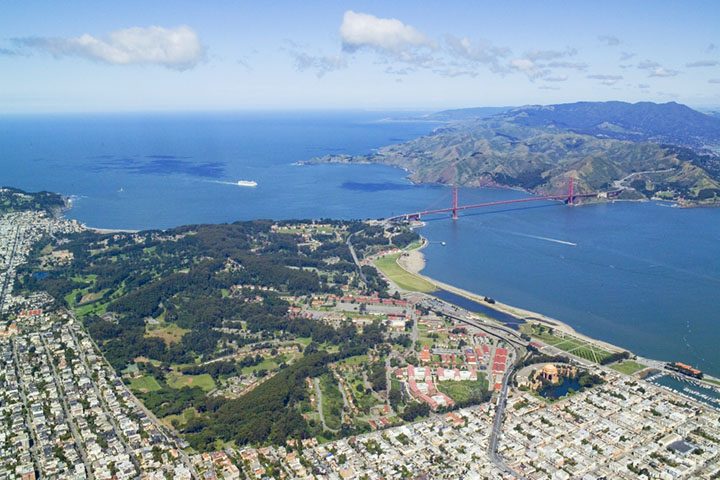
The Presidio in San Francisco is a former Army post of 1,491 acres at the northern tip of the city, next to the Golden Gate Bridge. Entry is free and the park is open 24 hours a day, all year. People come for a history under three flags, Spanish, Mexican and American, for beaches with bridge views, a planted forest, overlooks and free exhibits. Below: history, what to see, how to get there, hours and tips.
History of the Presidio: Spain, Mexico and the US Army
In 1769 Gaspar de Portola led a Spanish expedition to Alta California, and its members became the first Europeans to see San Francisco Bay. On June 27, 1776, Juan Bautista de Anza's expedition from Sonora reached the bay's entrance and set up the presidio, a military fort. It brought a Franciscan priest, 193 colonists and soldiers and about 1,000 head of livestock.
Life at the empire's northernmost post was hard. The National Park Service says a supply ship came at best once a year, and the settlement had 200 to 400 residents, often more women and children than men. In 1792 the British captain George Vancouver found it poorly supplied and fortified, and by 1794 Spain had built Castillo de San Joaquin with bronze cannons cast in Lima.
Mexico became a republic in 1821 and opened its ports to foreign trade. Traders came for sea otter and seal furs, hides and tallow, among them the Russian American Company, the Hudson's Bay Company and merchants from Boston. The same NPS page says Marcos Briones and the Miramontes family built homes near El Polin Spring, and that Russian sailors are said to have built a timber house nearby for Juana Briones, a landowner, businesswoman, rancher and healer. In 1835 General Mariano Vallejo moved his headquarters north to Sonoma, the Presidio was for a time abandoned, and the adobe walls slowly washed away in the winter rains.
US forces occupied the Presidio in 1846, and President Fillmore reserved it for the Army in November 1850. In the 1880s the Army began planting trees on the bare dunes; the forest now covers 306 acres, with about 75,000 trees in the park. After the earthquake of April 18, 1906, Presidio troops fought fires and handed out food, and a refugee tent camp stood on the site of Letterman Hospital. In 1924 the first dawn to dusk transcontinental flight landed at Crissy Field. In World War II Letterman peaked at 73,000 patients in one year, and in the 1950s the post was headquarters of the Sixth US Army.
The Presidio became a National Historic Landmark in 1962. Congress decided to close the post in 1989, and on October 1, 1994, it passed to the National Park Service. Two years later, in 1996, Congress created the Presidio Trust, a federal agency, to make the park financially self-sufficient by 2013. The Trust runs the park today with the NPS and the Golden Gate National Parks Conservancy. There are more than 737 buildings, 433 of them historic, and about 3,000 residents.
What to see in the Presidio
- Presidio Visitor Center, 210 Lincoln Boulevard on the Main Post: a large 3D model of the park with touch screens, an interactive table on the Presidio's history, and maps in English, Spanish and Chinese.
- Presidio Officers' Club, 50 Moraga Avenue: once a club for Army officers and their families, now home to the free Presidio History Exhibition. The Trust manages more than 30 archaeological areas, and the Presidio is one of the only national park sites with an active dig.
- Presidio Tunnel Tops, next to the visitor center: Golden Gate views, picnic sites, the Outpost nature playground and the Field Station. Free.
- Andy Goldsworthy's works: four installations on a three-mile walk. Wood Line and Spire stand along trails and can always be seen; Tree Fall is not open to visits now.
- Beaches: Baker Beach for sunsets beneath the bridge, Crissy Field East Beach with gentle waves for small children, and Marshall's Beach, reached only on foot from the Batteries to Bluffs Trail.
- Overlooks: Battery East Vista, Golden Gate Overlook and Pacific Overlook for the bridge, Crissy Field Overlook for the northern shore and skyline, Inspiration Point for the bay. Immigrant Point Overlook tells of the gateway through which newcomers arrived.
How to get to the Presidio
The free Presidio GO Shuttle Downtown Route runs from downtown to Presidio Transit Center in about 25 minutes. Board on Drumm Street just north of California Street, in front of the Hyatt; it also stops near Salesforce Transit Center, Embarcadero BART and Van Ness and Union Street. Visitors may not ride on weekday mornings from 7:30 to 9 a.m. or on the 4:30, 5, 5:30 and 6 p.m. trips unless they hold a Muni Visitor Passport. At Presidio Transit Center, the South Hills Route goes on to Baker Beach, the California Coastal Trail and the overlooks. The shuttle is only for trips to or from the Presidio and carries bike racks. Schedules are on the Presidio GO Shuttle page.
Muni buses:
- 43 Masonic stops at Presidio Transit Center, by the visitor center and Tunnel Tops, daily 5 a.m. to midnight, per SFMTA.
- 30 Stockton runs along Mason Street to Crissy Field from 6 a.m. to 8 p.m. daily, with a Mason St - Tunnel Tops stop.
- 28 19th Avenue stops at Golden Gate Bridge/Parking Lot.
- 29 serves Baker Beach, 1 stops a short walk from the southern gates, 45 right outside the Lombard Gate.
Golden Gate Transit buses from the North Bay stop on Highway 101 above the bridge Welcome Center and outside the Gorgas Gate. Parking is paid every day, Sundays included; the rate depends on the lot and the day, paid at a pay station or with PayByPhone.
Hours and tickets
| What | Hours | Price |
|---|---|---|
| The Presidio | 24 hours, all year | free |
| Presidio Visitor Center | daily 10 a.m. to 5 p.m., closed Thanksgiving, Christmas and New Year's Day | no price listed |
| Officers' Club exhibits | Friday to Sunday, 11 a.m. to 4 p.m. | free, no ticket |
| Presidio Tunnel Tops | open daily; some activities keep their own hours | free |
| Presidio GO, Downtown Route | weekdays 6 a.m. to 7 p.m., weekends 9 a.m. to 6 p.m. | free |
| Presidio GO, South Hills Route | weekdays 6 a.m. to 7 p.m., weekends 11 a.m. to 6 p.m. | free |
| Parking | daily | at pay station or PayByPhone |
Hours and prices checked November 5, 2026 on presidio.gov.
Tips before you go
- Bring a jacket in any season: the Presidio Trust warns that fog can roll in unexpectedly. Pack water and snacks too, since many beaches are far from restaurants.
- Dogs are welcome in most areas under leash rules. Coyotes live in the park; they returned in 2002.
- Rent a bike through Lyft Bike Share or at Sports Basement.
- Unpaid or overtime parking costs $50 if paid within 30 days, more after that.
More of the city is on what to see in San Francisco, and the San Francisco city guide covers the rest. Start at the visitor center, 210 Lincoln Boulevard.
Questions people ask
Is there an entrance fee for the Presidio?
No. The Presidio has no entrance fee and is open 24 hours a day, year-round. The Officers' Club exhibits, Presidio Tunnel Tops, the beaches and the Presidio GO Shuttle are free as well. Only parking costs money: the rate depends on the lot and the day, paid at a pay station or with PayByPhone.
How do I get to the Presidio without a car?
Take the free Presidio GO Shuttle from Drumm Street in front of the Hyatt downtown to Presidio Transit Center, about 25 minutes. Muni's 43 Masonic also stops there, and the 30 Stockton reaches Crissy Field during the day. Visitors cannot ride the shuttle on weekday mornings or on some evening trips.
Does the Presidio have a Russian connection?
The National Park Service says that after Mexico opened its ports in 1821, the Russian American Company was among the traders who came for furs and hides. The same page says Russian sailors are said to have built a timber house near the Presidio for Juana Briones, a local landowner and rancher.
Who runs the Presidio today?
The former post became part of a national park on October 1, 1994. It is managed by the Presidio Trust, a federal agency created by Congress, working with the National Park Service and the nonprofit Golden Gate National Parks Conservancy. The park has more than 737 buildings, 433 of them historic.
Places on the map
Sources
- Presidio Trust: The Presidio
- Presidio Trust: Frequently asked questions
- Presidio Trust: Presidio Visitor Center
- Presidio Trust: Presidio Officers' Club
- Presidio Trust: Presidio Tunnel Tops
- Presidio Trust: Art in the Presidio
- Presidio Trust: Beaches
- Presidio Trust: Scenic overlooks
- Presidio Trust: Presidio GO Shuttle
- Presidio Trust: Public transit to the Presidio
- Presidio Trust: Parking in the Presidio
- NPS Presidio of San Francisco: History and culture
- NPS: Spanish Period
- NPS: Mexican Period
- NPS: U.S. Military Period
- NPS: 1906 Earthquake
- NPS: National Park Period (post to park)
- SFMTA: 43 Masonic
- SFMTA: 30 Stockton
- SFMTA: 28 19th Avenue
- Presidio Trust: A brief history of the Presidio