RussiansInUSA editorial team · Facts checked November 5, 2026 · Official site
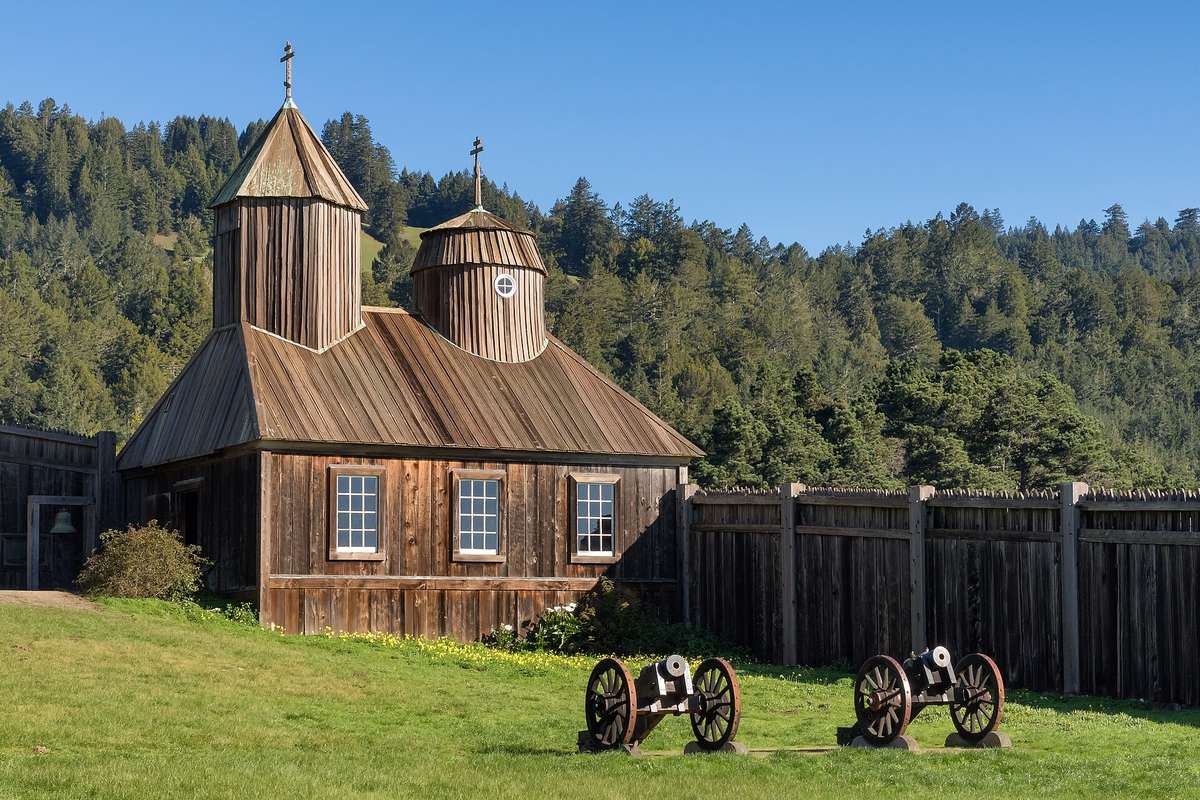
Fort Ross is the former Russian-American Company settlement on the Sonoma County coast north of San Francisco. Russians lived here from 1812 to 1841, and it was the southernmost Russian settlement in North America. Today it is Fort Ross State Historic Park, at 19005 Coast Highway One, Jenner, CA 95450, 12 miles north of Jenner on Highway 1. Inside the reconstructed wooden stockade stand the Rotchev House, which the park believes is one of the only original buildings left from the Russian period, and a rebuilt chapel.
Fort Ross history: Metini, Kuskov and the Russian-American Company
Long before the Russians came, this was Metini, a village of the Kashaya Pomo. A California State Parks brochure says the village, between the Gualala and Russian rivers, had been theirs for centuries. They moved with the seasons from ridgetop villages to camps on the coast, where they gathered shellfish, fished and harvested sea salt. They were known for their baskets. The park names this land the ancestral homeland of the Kashia Band of Pomo Indians of the Stewarts Point Rancheria.
Tsar Paul I chartered the Russian-American Company in 1799 and gave it a monopoly on Russian enterprise in North America. Its chief manager, Alexander Baranov, sent his assistant Ivan Kuskov south. In January 1809 Kuskov reached Bodega Bay on the ship Kodiak with 40 Russians and 150 Alaska Natives and took more than 2,000 sea otter pelts back to Alaska. In 1812 he returned with 25 Russians and 80 Alaska Natives, Alutiiq among them, and built a settlement 18 miles north of Bodega Bay. The brochure says the colony was dedicated on August 30, 1812, and named Ross, for Russia.
The colony was meant to grow wheat for Russian Alaska, hunt marine mammals and trade with Spanish California. It had a smithy, a tannery, brick and barrel making and a shipyard; the Rumiantsev, finished in 1818, was the first ship built in California. The park also credits Fort Ross with California's first windmills. By 1820 American, Spanish and Russian hunters had nearly wiped out the otters, and the company banned hunting for a time, which the park calls the first marine mammal conservation laws in the Pacific.
Few Russian men and fewer Russian women lived at Ross. Their neighbors were native Siberians, Alaska Natives, Hawaiians, Native Californians and people of mixed ancestry. Lower-ranking workers lived in a village outside the stockade; the Alaska Natives had their own village on a bluff above a cove. Naturalist Ilya Voznesenskii spent 1840 at Ross, and many of his specimens and the native artifacts he collected, such as Kashaya baskets, are on display today in the Kunstkamera in St. Petersburg.
In December 1841 the company sold Fort Ross to John Sutter, whose assistant John Bidwell moved the livestock and hardware to the Sacramento Valley. George W. Call bought the land in 1873 and ran an 8,000-acre ranch that shipped cordwood, railroad ties, fence posts, tanbark, apples and dairy products. In 1903 the California Historical Landmarks Committee bought the stockade area, and in 1906 it passed to the state. The National Park Service lists Fort Ross among California's National Historic Landmarks, designated November 5, 1961, and says the settlement as a whole retains that designation.
What to see at Fort Ross
Start at the visitor center, with its exhibits and research library. The fort is 0.3 miles away on the paved Fort Trail.
The Rotchev House was remodeled around 1836 for Alexander Rotchev, the last manager, who lived there with his wife Elena. It is listed in the National Register of Historic Places.
The chapel, the first Russian Orthodox chapel south of Alaska, dates from about 1825. The April 1906 earthquake knocked it down, restoration began in 1916, and a fire destroyed it on October 5, 1970. It was completely rebuilt in 1973. The chapel had been made a National Historic Landmark on its own in 1969; with its original materials lost, the NPS withdrew that designation on December 7, 1971. This applies to the chapel only, not to the settlement.
Also reconstructed: the redwood stockade, the northwest and southeast blockhouses, the Kuskov House, the Officials' Quarters and the fur warehouse. A replica windmill went up in 2012. Outside the fort are the 1878 Call House and the historic orchard, the Russian-American Company cemetery and trails down to Sandy Cove.
How to get to Fort Ross from San Francisco
The park describes only the drive; its page says nothing about public transit. One section gives 2.5 hours from San Francisco, another 3.5. Santa Rosa is about 1.5 hours.
- Via Petaluma: take US 101 to the East Washington Street exit and go west. The road becomes Bodega Avenue and then Highway 1 to Bodega Bay. Continue north on Highway 1 past Jenner.
- Via Santa Rosa: take 101 to the River Road exit north of town and go west. In Guerneville it becomes Highway 116; follow signs to Highway 1 North toward Jenner.
Park in the lot by the visitor center; it closes at sunset. Buses and vans may drop people at the fort but may not park there.
Hours and fees
| What | Hours or fee |
|---|---|
| Fort compound | 9:00 a.m. - 3:30 p.m. |
| Visitor center | 10:00 a.m. - 4:30 p.m. |
| Vehicle day use | $10 |
| Vehicle, visitor 62 or older | $9 |
| Disabled Discount Pass | $5 off |
| Bus, 24 seats or fewer / 25 or more | $50 / $100 |
Hours and fees checked November 5, 2026 on parks.ca.gov.
The site does not list days of operation, and special rates may apply on weekends, holidays and in peak season. In the off-season the park asks visitors to call the kiosk at (707) 847-3629. State annual passes such as California Explorer and Golden Poppy are accepted. Events are listed on the park's page.
Tips before you go
The park warns that fog, wind, sun and rain can all come on the same day, so bring a warm layer. Its brochure warns of rip currents and large waves, says there are no lifeguards and tells visitors never to turn their back to the water. Asked whether dogs are allowed, the park's site says "Yes"; for the rules on dogs, call the park's general information line at (707) 847-3629. Reef Campground, just south of the fort, is seasonal: 20 first-come, first-served sites, dry, with no hookups, and for now tents only, no trailers, campers or RVs.
Pair the trip with our San Francisco city guide and the list of places to see in San Francisco. The livestock from Ross went to Sacramento, home of Sutter's Fort.
Questions people ask
How much does it cost to visit Fort Ross?
Fort Ross State Historic Park charges $10 per vehicle for day use, or $9 if you are 62 or older. The Disabled Discount Pass takes $5 off. Buses pay $50 for 24 seats or fewer and $100 for 25 or more. Special rates may apply on weekends and holidays, so check parks.ca.gov before you go.
What is original at Fort Ross from the Russian period?
The park believes only the Rotchev House is original, remodeled around 1836 for the last manager, Alexander Rotchev. The chapel, stockade, Kuskov House, Officials' Quarters, fur warehouse and two blockhouses are reconstructions. The chapel itself was rebuilt from scratch in 1973 after a fire in 1970.
Who lived at Fort Ross?
The Russian-American Company settlement was multicultural. There were few Russian men and fewer Russian women. Alongside them lived Alaska Natives, including Alutiiq, native Siberians, Hawaiians, Native Californians and people of mixed ancestry. The land itself, the village of Metini, had been home to the Kashaya Pomo for centuries.
When did the Russians leave Fort Ross?
Russians lived at Fort Ross for almost 30 years, from 1812 to 1841. By 1820 the sea otters had been nearly hunted out. In December 1841 the Russian-American Company sold Fort Ross to John Sutter, and his assistant John Bidwell moved the livestock and hardware to the Sacramento Valley.
Places on the map
Sources
- California State Parks: Fort Ross State Historic Park
- California State Parks: About the Fort (Fort Ross)
- California State Parks: Fort Ross State Historic Park brochure (rev. 2018)
- California State Parks: Fort Ross accessible features
- NPS National Historic Landmarks: Fort Ross Chapel (withdrawn)
- NPS: National Historic Landmarks by state (California)