RussiansInUSA editorial team · Facts checked November 5, 2026 · Official site
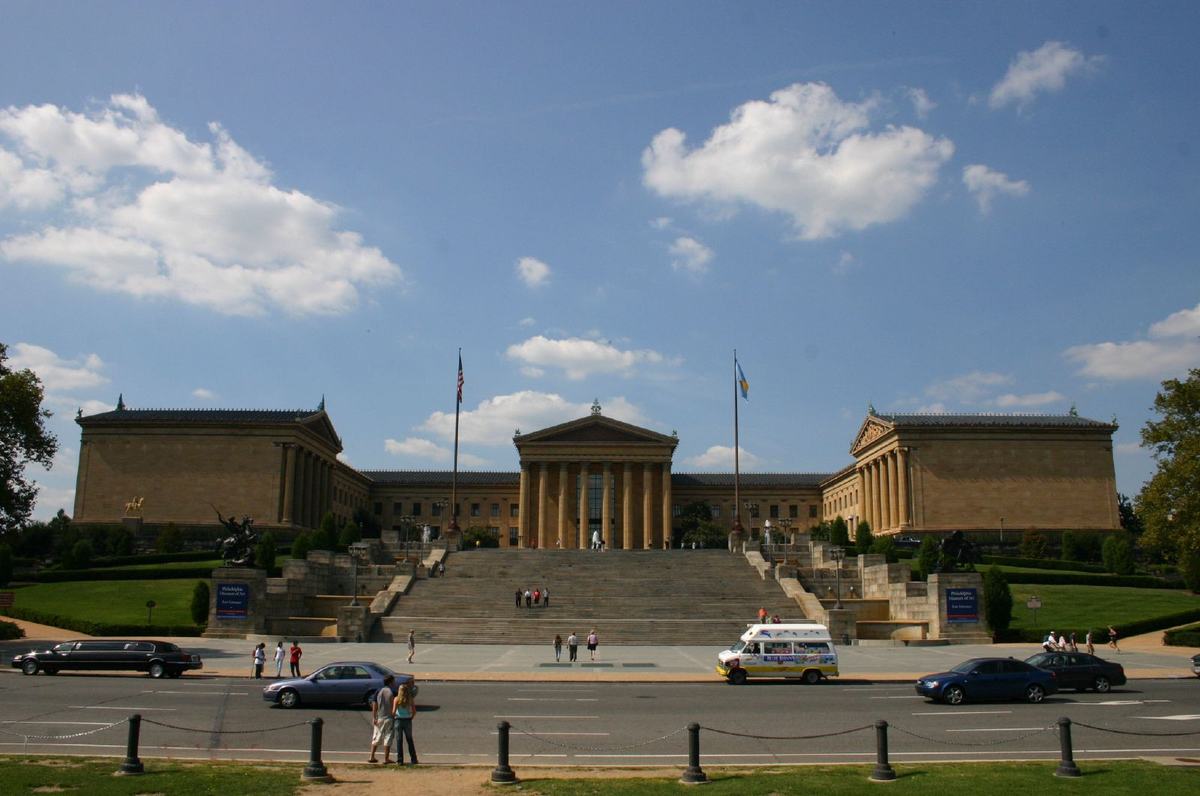
The Philadelphia Museum of Art sits on Fairmount hill at the end of the Benjamin Franklin Parkway, at 2600 Benjamin Franklin Parkway. Its main building is famous for the Rocky Steps, which climb to the East Terrace and its view of the Center City skyline. Inside are 200 galleries and a collection of more than 200,000 objects. Below: the history of the building and the statue, what to see, how to get there, hours and tickets.
History of the museum and the Rocky Steps
The museum grew out of the 1876 Centennial Exhibition in Fairmount Park, held for the 100th anniversary of American independence. The Pennsylvania Museum and School of Industrial Art was chartered in February 1876. After the fair, its Art Gallery was renamed Memorial Hall and reopened as a museum on May 10, 1877.
In 1907 Mayor John E. Rayburn was told the new museum should stand on Fairmount hill, the city's highest natural elevation and the site of its first reservoir. The final plan was adopted in March 1917, the work of Zantzinger, Borie and Medary, Paul Cret and Horace Trumbauer's firm, including senior designer Julian Abele, the first African American graduate of the University of Pennsylvania's architecture program. Because of World War I, construction began only in July 1919.
By 1923 the builders had terraced the granite hill and laid the steps now known as the Rocky Steps. The building opened on March 26, 1928, with much of the interior unfinished, and drew one million visitors in its first year. At the end of the 1930s the museum officially took the name Philadelphia Museum of Art. Frank Gehry was chosen in 2006 to expand and restore the main building, and his Core Project opened on May 7, 2021, with new galleries, a renovated West Entrance and the Williams Forum.
The Rocky statue is a bronze by A. Thomas Schomberg, made in 1980 and 8 feet 6 inches tall. According to the Association for Public Art, it is unveiled at the museum in Rocky III (1982), and that year Sylvester Stallone gave it to the City of Philadelphia. After a long debate over whether a movie prop belonged there, it went to the Spectrum in South Philadelphia, came back briefly for Rocky V in 1990, and in 2006 was placed beside the foot of the steps. In January 2026 the Philadelphia Art Commission approved installing it permanently atop the steps, on the East Terrace. After a spell indoors in the museum exhibition "Rising Up: Rocky and the Making of Monuments", it was fixed to its pedestal at the top of the steps in September 2026, The Philadelphia Inquirer reported, citing the city arts office Creative Philadelphia.
What to see inside
If your visit depends on one particular work, the museum asks you to email VisitorServices@philamuseum.org first: art is sometimes off view for conservation or on loan. It aims to reply within 72 hours.
- Great Stair Hall. Augustus Saint-Gaudens's bronze Diana, made as a weathervane for the second Madison Square Garden in New York, arrived in 1932. The thirteen woven panels of the "History of Constantine the Great", a 1959 gift of the Samuel H. Kress Foundation, hang here too.
- European painting. Paul Cezanne's The Large Bathers came in 1937. Van Gogh's Sunflowers, Monet's Japanese Footbridge and Renoir's The Large Bathers came in 1963 with the Tyson bequest.
- Duchamp and Brancusi. Walter and Louise Arensberg's 1950 gift brought the largest group of Brancusi sculptures outside Paris and the world's foremost Duchamp collection. At the end of the 1960s Duchamp quietly offered the museum Étant donnés, a work nobody knew about.
- Asian architecture. The wing that opened in 1957 holds a Japanese ceremonial teahouse with bamboo gardens, the Reception Hall from the Palace of Duke Zhao and the Pillared Temple Hall from India, built from granite sculptures from Madurai given in 1919.
- Arms and armor. The Kretzschmar von Kienbusch Collection opened on October 1, 1977.
- The East Terrace. Jacques Lipchitz's Prometheus Strangling the Vulture came in 1953 and still greets visitors there.
The free audio tour runs in the Bloomberg Connects app, in English, Mandarin, French, German, Japanese, Spanish and Korean. Bring your own headphones.
How to get to the museum
- Bus: SEPTA says Route 38 stops at the museum, and Routes 7, 32, 48 and 49 run between Fairmount Park and 21st Street. Schedules are on septa.org.
- Train: the museum suggests SEPTA subway or Regional Rail to 30th Street or Suburban Station, then checking the walk on a map. PATCO comes in from South Jersey, Amtrak stops at 30th Street.
- Bike: there is an Indego station at the bottom of the Rocky Steps and another at the Perelman Building, 2525 Pennsylvania Avenue.
- Car: the garage is at 1 Anne d'Harnoncourt Drive, with entrances on Anne d'Harnoncourt Drive and Water Works Drive, plus a few spaces on the West Terrace lots. Parking is $9 an hour, or $10 total on Fridays from 5 to 9 p.m.
Hours and tickets
| Day | Hours |
|---|---|
| Monday, Thursday, Saturday, Sunday | 10 a.m. to 5 p.m. |
| Friday | 10 a.m. to 8:45 p.m. |
| Tuesday and Wednesday | Closed |
| Visitor | Price |
|---|---|
| Adults | $30 |
| Seniors (65 and over) | $28 |
| Students with valid ID | $14 |
| Youth 18 and under | Free |
| Members | Free |
Hours and prices checked November 5, 2026, on philamuseum.org.
A full-price ticket covers two consecutive days at the museum and the Rodin Museum. Admission is pay what you wish on the first Sunday of the month, bookable online. Pay-what-you-wish Friday nights, 5 to 8:45 p.m. with a suggested $15, are billed as a limited offer running through June 2027, so check the Main Building page before you go. PA ACCESS and EBT cardholders get free general admission for four adults. Children still need a free ticket. Buying online lets you skip the admissions desk line.
You do not need a museum ticket to see the Rocky statue.
Before you go
- Every visitor and bag is screened, which may include the Evolv Express weapons-detection system.
- Backpacks, bags larger than 16 x 16 x 8 inches, large umbrellas and selfie sticks are not allowed in the galleries; leave them at coat check. Carry small bags on one shoulder or by hand.
- No food or drink in the galleries; reusable water bottles stay closed and put away.
- Personal photos are fine without flash, lights or tripods.
- Sketch with graphite pencils only.
- Free public tours run daily and are included with admission, no reservation needed.
Plan the rest of the day with our Philadelphia city page and the list of places to see in Philadelphia.
Questions people ask
Do I need a ticket to see the Rocky statue?
No. The Philadelphia Museum of Art says admission is not required to visit the Rocky statue, which since September 2026 stands at the top of the steps on the East Terrace. The bronze statue by A. Thomas Schomberg belongs to the City of Philadelphia. A ticket is needed only to enter the building and its 200 galleries.
When is the Philadelphia Museum of Art pay what you wish?
On the first Sunday of every month, with tickets bookable online. The museum also runs pay-what-you-wish Friday nights from 5 to 8:45 p.m. with a suggested $15 donation, which it calls a limited offer running through June 2027, so confirm on its site. Visitors 18 and under are always free.
What days is the museum closed?
The main building is closed every Tuesday and Wednesday. Holiday hours are posted on the Main Building page at philamuseum.org, so check it before a holiday visit. Other days it is open 10 a.m. to 5 p.m., and until 8:45 p.m. on Fridays.
Can I bring a backpack to the museum?
You can bring one to the building, but backpacks are not allowed in the galleries. They go to coat check, along with bags larger than 16 x 16 x 8 inches, large umbrellas and selfie sticks. Smaller bags must be carried on one shoulder or by hand, and every bag is screened at the entrance.
Places on the map
Sources
- Philadelphia Museum of Art (official site)
- Main Building: hours, admission, getting here, parking
- Know Before You Go: visitor guidelines, security, photography
- Museum FAQs: tickets, pay what you wish, Rocky statue
- Our History, Philadelphia Museum of Art
- About the Philadelphia Museum of Art
- Parking, Philadelphia Museum of Art
- SEPTA: Fairmount/Art Museum Area
- Association for Public Art: Rocky
- The Philadelphia Inquirer: the Rocky statue is now at the top of the Art Museum steps (September 2026)