RussiansInUSA editorial team · Facts checked November 5, 2026 · Official site
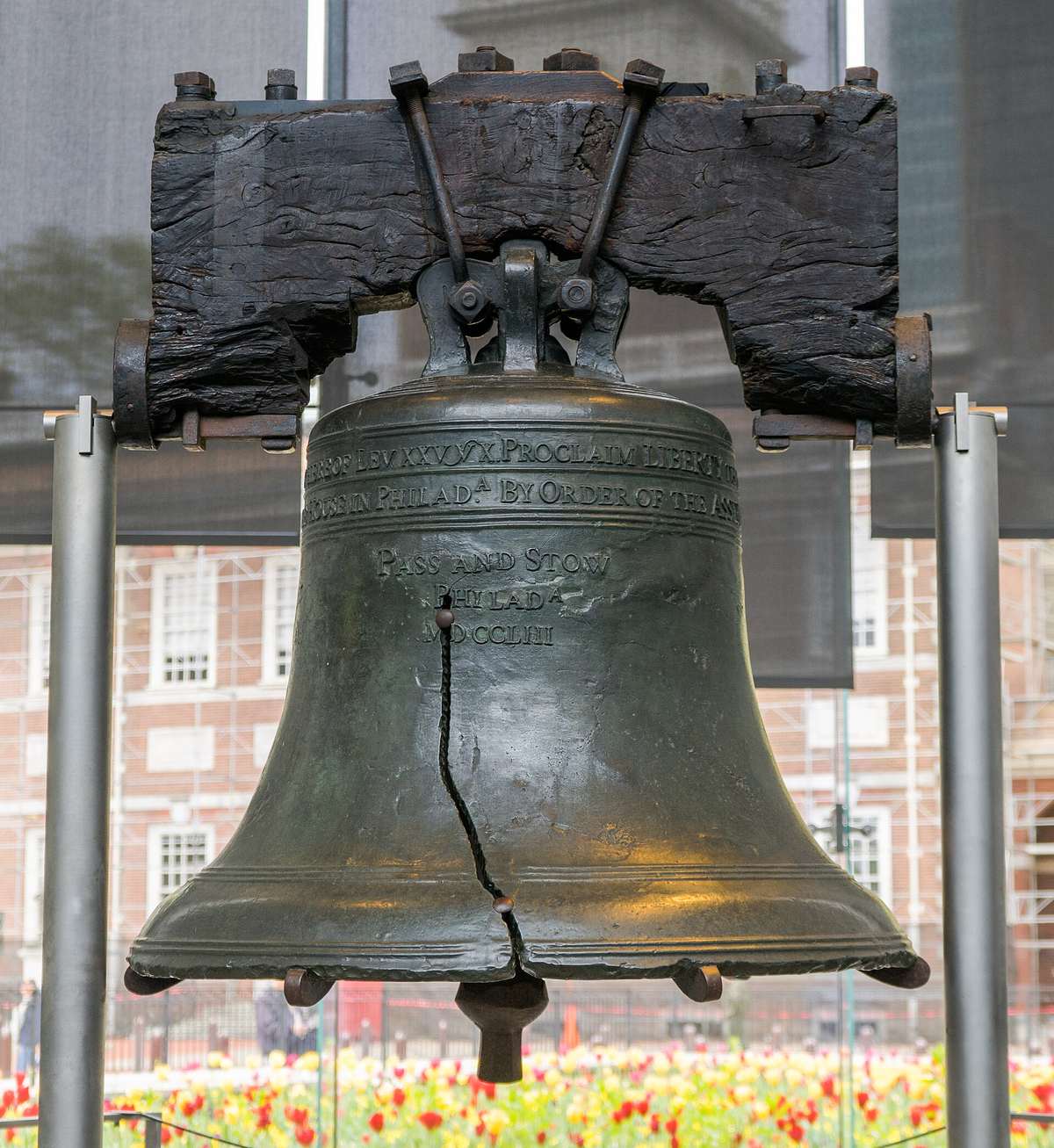
The Liberty Bell hangs in the Liberty Bell Center, a building of Independence National Historical Park at 526 Market Street in Center City Philadelphia. It is a bronze bell cast in 1753, known for its crack and for an inscription about liberty that abolitionists took up in the 1800s. Entry is free and no tickets are needed, but everyone goes through security screening. Below: the bell's history as the National Park Service (NPS) tells it, what to see, how to get there and the hours. More of the city is on our Philadelphia page.
Liberty Bell history: from State House bell to symbol
The bell was ordered for the tower of the Pennsylvania State House, the building we now call Independence Hall. Per the NPS, Isaac Norris, Speaker of the Pennsylvania Assembly, ordered a bell in 1751 from the Whitechapel Foundry in London. It cracked on the first test ring. Local metalworkers John Pass and John Stow melted it down and cast a new one in Philadelphia. Its face reads "Pass and Stow, Philada, MDCCLIII", that is, 1753.
The bell called lawmakers to meetings and townspeople to hear the news read. The NPS quotes Benjamin Franklin writing to Catherine Ray in 1755 that the bell was ringing and he had to go talk politics. There is evidence the bell rang to mark the Stamp Act and its repeal, the NPS says, but no evidence that it rang on July 4 or 8, 1776.
The crack: why the bell went silent
No one recorded when or why the bell first cracked. The NPS calls a narrow split in the early 1840s, after nearly 90 years of use, the most likely explanation. In 1846 the city wanted it repaired before the George Washington's birthday holiday on February 23. Metalworkers widened the thin crack to stop it spreading and restore the tone, a technique called stop drilling.
The wide "crack" visitors see is that repair; look closely and you can count over 40 drill bit marks. The repair failed. The Public Ledger reported a new fissure, running from "Philada" up through the word "Liberty", and it silenced the bell for good. In 1999, Penn State graduate students built a computer model of the bell and, knowing its tone was E-flat, recreated roughly how it sounded.
The cracked bell was still struck on special occasions. On D-Day, June 6, 1944, Philadelphia Mayor Bernard Samuel struck it seven times, once for each letter of "Liberty", in a nationwide radio broadcast.
The inscription and how it got its name
Two lines run around the top. The first is from the King James Bible, Leviticus 25:10: "Proclaim Liberty Throughout All the Land Unto All the Inhabitants thereof." The verse refers to the Jubilee, when every 50 years the Israelites were told to return property and free slaves. The second line says the Assembly of the Province of "PENSYLVANIA" ordered the bell for its State House.
Norris chose the verse in 1751, possibly for the 50th anniversary of William Penn's 1701 Charter of Privileges, which gave Pennsylvanians religious liberty and self-government. The inscription went unnoticed during the Revolutionary War. Afterward, abolitionists made it a rallying cry. The Anti-Slavery Record first called it the Liberty Bell in 1835, though the name caught on years later, and George Lippard's 1847 story "Ring, Grandfather, Ring" made the bell famous.
From the late 1800s the bell traveled the country to expositions and fairs. Pennsylvania suffragists commissioned a replica, the Justice Bell, which toured the state in 1915 and then sat chained in silence until the 19th Amendment passed in 1920. The Civil Rights movement embraced the bell too.
What to see at the Liberty Bell Center
The bell itself. The NPS says plainly that it is the one and only original; there are many replicas. It weighed 2,080 pounds when ordered and is bronze: 70% copper, 25% tin, with small amounts of lead, gold, arsenic, silver and zinc. The clapper weighs 44.5 pounds and the American elm yoke 200 pounds, though there is no proof the yoke is original.
Exhibits line the left side of the hallway, from the founding of the State House bell to its use by abolitionists and civil rights advocates. Park rangers tell the bell's story, and written information is available in a dozen languages; ask a ranger.
Two other bells are nearby. The Centennial Bell, made for 1876, still rings every hour in the Independence Hall tower and weighs 13,000 pounds, a thousand for each original state. The Bicentennial Bell, a gift from the people of Great Britain in 1976, is in the Benjamin Rush Garden at 3rd and Walnut Streets. At the Independence Visitor Center you can touch a replica of the crack.
How to get to the Liberty Bell
The NPS suggests starting at the Independence Visitor Center, 6th and Market Streets, which has rangers, restrooms and a cafe.
- SEPTA Market-Frankford Line. 5th St/Independence Hall station is at 5th and Market Streets and is ADA accessible. From Amtrak's 30th Street Station, the NPS says to ride the line eastbound to 5th Street.
- SEPTA Regional Rail. All lines reach Center City. The closest stop is Jefferson Station at 11th and Market, about a 10-minute walk east. The Airport Line runs there from the airport.
- Bus. SEPTA routes 17, 33, 38, 44 and 48 serve the 5th St/Independence Hall station.
- PATCO from New Jersey. 8th Street station, at 8th and Market Streets.
- By car. The paid AutoPark at Independence Mall sits under the visitor center, GPS address 41 N. 6th Street, Philadelphia, PA 19106, with entrances on 5th and 6th Streets between Market and Arch. Another paid garage is on 2nd Street between Chestnut and Walnut.
Hours and admission
| Liberty Bell Center | |
|---|---|
| Address | 526 Market Street |
| Hours | daily, 9 am to 5 pm |
| Security screening | closes at least 5 minutes before the building |
| Admission | free, no tickets |
| Entry | first come, first served |
| Accessibility | wheelchair accessible |
Hours and prices checked November 5, 2026 on nps.gov. The NPS history page notes that hours vary seasonally, so check the park's hours page before you go. For weather closures, call the park at 215-965-2305.
Tips before you go
- Screening. Everyone and everything is checked: pockets, bags, medical devices, under strollers and wheelchairs. Bags go through an x-ray or are inspected by hand, and visitors walk through a metal detector.
- Not allowed. Firearms, knives, explosives or any other weapons. No open food or drink, such as a tray of fries or a disposable coffee cup. Bottles with screw-on lids are fine.
- No restrooms. The center has none at all. The closest are in the Independence Visitor Center at 6th and Market.
- Photos. Photography, flash included, is allowed in park buildings, but tripods are banned throughout the park and no photos are allowed in screening areas.
- Pets. Leashed pets are welcome on the grounds but not in buildings; service dogs may enter.
- Exit. Visitors leave from the south end of the building, near Chestnut Street. Independence Hall has its own rules: tickets are required for its tours at times.
For more nearby, see what to see in Philadelphia.
Questions people ask
Do you need tickets to see the Liberty Bell?
No. The National Park Service says admission to the Liberty Bell Center is free and no tickets are required; entry is first come, first served. Everyone passes through security screening with a metal detector and a bag check, and the center is open daily from 9 am to 5 pm.
Why is the Liberty Bell cracked?
No one recorded when it first cracked, most likely in the early 1840s. In 1846 metalworkers widened the thin crack by stop drilling, and the wide line visitors see is that repair. It failed when a second crack opened from "Philada" up through "Liberty", silencing the bell for good.
Is the bell in the Liberty Bell Center the real one?
Yes. The National Park Service says the bell on display is the one and only original, cast by John Pass and John Stow in Philadelphia in 1753. There are many replicas, such as the Justice Bell that Pennsylvania suffragists took on tour in 1915.
What is the closest SEPTA station to the Liberty Bell?
The 5th St/Independence Hall station on SEPTA's Market-Frankford Line, at 5th and Market Streets, is closest. From Amtrak's 30th Street Station the National Park Service suggests riding that line eastbound. The Liberty Bell Center is at 526 Market Street, a short walk from the station.
Places on the map
Sources
- Visiting the Liberty Bell Center (NPS)
- The Liberty Bell (NPS)
- The Sound of the Liberty Bell (NPS)
- Operating Hours and Seasons, Independence NHP (NPS)
- Directions, Independence NHP (NPS)
- Frequently Asked Questions, Independence NHP (NPS)
- Independence Visitor Center (NPS)
- Fees and Passes, Independence NHP (NPS)
- 5th St/Independence Hall Station (SEPTA)