RussiansInUSA editorial team · Facts checked November 5, 2026 · Official site
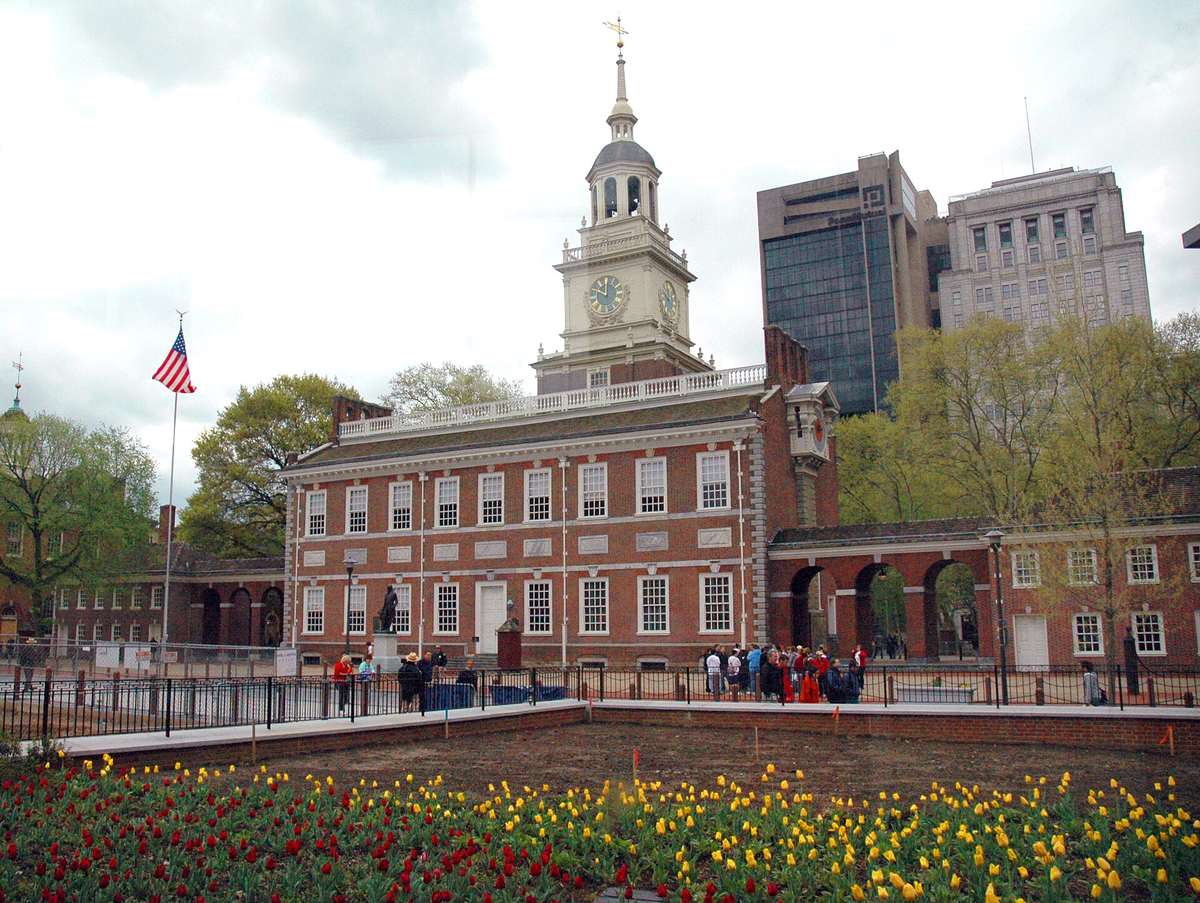
Independence Hall is the former Pennsylvania State House at 520 Chestnut Street in Philadelphia, between 5th and 6th Streets. The Declaration of Independence and, eleven years later, the U.S. Constitution were both debated and signed in one of its rooms. Today it belongs to Independence National Historical Park and is a UNESCO World Heritage Site. Below: the building's history, what you see inside, how to get there, and how the free tickets and security screening work. The rest of the city is on our Philadelphia page.
Independence Hall history, from colonial State House to national symbol
According to the National Park Service (NPS), construction began in 1732. Andrew Hamilton, Speaker of the Pennsylvania Assembly, oversaw the work, and master builder Edmund Woolley drew the designs. The Assembly moved in during September 1735, while parts were still being built. The State House first held all three branches of the colony's government.
The building, without its tower, was finished in 1748. The Assembly authorized a bell tower in 1750, and the tower and wooden steeple were complete by 1753. By 1773 the steeple had rotted, and it came down in 1781. In 1828 the city hired architect William Strickland to rebuild it; he added a clock and extra ornament that the original never had.
In May 1775, about a month after Lexington and Concord, the Pennsylvania legislature lent its Assembly Room to the Second Continental Congress. Here Congress approved George Washington as commander in chief of the new army. It voted for independence on July 2, 1776, approved the Declaration on July 4, and the Declaration was signed in this room on August 2, 1776. The Articles of Confederation, the nation's first framework of government, took effect in 1781.
The Articles proved unsatisfactory, and in May 1787 the room was lent to the Constitutional Convention. In about four months the delegates produced the Constitution, which Washington called "little short of a miracle." That year Benjamin Franklin, as NPS tells it, studied the "Rising Sun" chair, made in Philadelphia by John Folwell in 1779 for the Assembly's speaker.
The building declined in the 19th century. Before the Marquis de Lafayette's visit in 1824, the Assembly Room was first called the "Hall of Independence" and the yard became Independence Square. An 1831 restoration by John Haviland got details wrong, and NPS later removed it. In the 1890s, after the last city offices left, a more accurate restoration brought it closer to its Revolutionary-era look. NPS also notes a darker chapter: fugitive slave hearings were held here.
Congress created Independence National Historical Park on June 28, 1948. For the Bicentennial in 1976 the hall was restored again, guided by 18th-century drawings, documents and paint analysis. It became a World Heritage Site in 1979.
What to see at Independence Hall
The Assembly Room. The center of the tour, where both founding documents were signed. Tables stand in two rows with an aisle, northern states on the north side and southern on the south; NPS says no one knows the real seating. The furniture is of the period, chosen from surviving bills and repair records, but not original. The only original pieces are George Washington's chair and the silver inkstand used to sign the Declaration and Constitution.
The outside. A Georgian building: a 105-foot main block, two covered arcades and two 50-foot wings. The north front has marble keystones over the windows and a wooden balustrade between the chimneys; the south side has a Venetian window. The reconstructed clock is on the west side.
The West Wing. The Legacies of Independence exhibit shows original printed copies of the Declaration, the Articles of Confederation and the Constitution, plus the Syng inkstand, believed to be the one the signers of the Declaration used. No ticket needed.
Congress Hall, at 6th and Chestnut, housed the U.S. Congress from 1790 to 1800 while Philadelphia was the temporary capital, the Senate upstairs and the House below. Presidents Washington and Adams were inaugurated there. Old City Hall was home to the U.S. Supreme Court from 1791 to 1800.
The Liberty Bell is nearby, in the Liberty Bell Center at 526 Market Street, free and without tickets; it has its own page on our site. More sights are in things to see in Philadelphia.
How to get to Independence Hall
- Subway. SEPTA's Market-Frankford Line (L) to 5th St/Independence Hall station, at 5th and Market. septa.org lists it as wheelchair accessible. From Amtrak's 30th Street Station, NPS suggests riding this line east to 5th Street.
- SEPTA buses. Routes 17, 33, 38, 44 and 48 serve the station. SEPTA and NJ Transit buses also stop near 6th and Market.
- Regional Rail. All lines reach Center City. The closest stop is Jefferson Station at 11th and Market, about a 10-minute walk (6 blocks) to the Visitor Center. The Airport Line runs there from Philadelphia International Airport.
- From New Jersey. PATCO to 8th Street station (8th and Market), then two blocks east.
- By car. AutoPark at Independence Mall is a paid underground garage below the Visitor Center, entrances on 5th and 6th between Market and Arch, GPS address 41 N. 6th Street. AutoPark at Olde City is on 2nd Street between Chestnut and Walnut.
NPS suggests starting at the Independence Visitor Center, 6th and Market Streets.
Independence Hall hours and tickets
The tours are free. Each ticket carries a $1.00 fee that is not refunded and is not covered by NPS passes.
| What | When | Ticket |
|---|---|---|
| Open house | 9:00-10:30 am | not needed |
| Ranger-led tours (from November 1) | every 20 minutes, 10:40 am-4:40 pm | required, $1.00 fee |
| West Wing exhibit | daily 9 am-5 pm | not needed |
| Congress Hall | open house 9-10 am, tours every 20 minutes 10 am-4:40 pm | not needed |
Hours and prices checked November 5, 2026 on nps.gov. NPS changes the time of the last tour by season: from November 1 it starts at 4:40 pm, before that at 4:20 pm. So check the Independence Hall page on the day you go.
Book at recreation.gov or by phone at 1-877-444-6777 (10 am to midnight). Tickets open up to 30 days ahead, and next-day tickets are released at 5 pm the day before. Each account can hold up to 10. Unbooked tickets stay available until the tour time. Print the ticket or show it on your phone.
Security screening and tips
- Entrance. Screening is on the south side of the building, by the stairs or ramp on 5th Street between Chestnut and Walnut. After screening, the tour line forms behind the hall.
- Arrive early. NPS asks for 30 minutes before your tour. Screening closes 15 minutes before the building does, or earlier if every tour is full.
- Not allowed. Weapons, knives and explosives. No open food or drink containers; bottles with screw-on lids are fine. Everyone and everything is screened, including pockets, bags and medical devices. For the West Wing, NPS recommends small bags only.
- Access. The first floor is wheelchair accessible. Audio description and assistive listening devices are available on request. For ASL interpretation, book tickets first, then call the park at 215-965-2305 at least 14 days ahead.
- No ticket? Come at 9:00 am for the open house, when none is needed until 10:30. recreation.gov notes that entry then is not guaranteed if it gets too crowded, so come early.
Questions people ask
Does Independence Hall cost anything?
The ranger-led tours of Independence Hall are free, but booking on recreation.gov adds a $1.00 fee per ticket. It is not refundable and NPS passes do not cover it. During the open house from 9:00 to 10:30 am no ticket is needed at all.
Can I visit Independence Hall without a reservation?
Yes, during the open house from 9:00 to 10:30 am, when no ticket is required. Unbooked tickets also stay available on recreation.gov until the tour time, and next-day tickets are released at 5 pm the day before. Everyone enters through screening on the south side, from 5th Street.
Can you see the original Declaration and Constitution there?
Printed ones, yes. The West Wing exhibit shows original printed copies of the Declaration of Independence, the Articles of Confederation and the Constitution, along with the Syng inkstand. It is open daily from 9 am to 5 pm, with no ticket, after security screening.
What is the closest subway stop to Independence Hall?
5th St/Independence Hall station on SEPTA's Market-Frankford Line (L), at 5th and Market Streets. septa.org lists it as wheelchair accessible, and bus routes 17, 33, 38, 44 and 48 stop nearby.
Places on the map
Sources
- Independence Hall, Plan Your Visit (NPS)
- Independence Hall Tickets (NPS)
- Independence Hall (NPS)
- Architecture of Independence Hall (NPS)
- Assembly Room of Independence Hall (NPS)
- Independence Hall: International Symbol of Freedom (NPS)
- West Wing, Legacies of Independence (NPS)
- Congress Hall (NPS)
- Congress Hall history (NPS)
- Old City Hall (NPS)
- Liberty Bell Center (NPS)
- Directions, Independence NHP (NPS)
- 5th St/Independence Hall Station (SEPTA)
- Independence Hall Tour tickets (Recreation.gov)
- Frequently Asked Questions, Independence NHP (NPS)