RussiansInUSA editorial team · Facts checked November 5, 2026
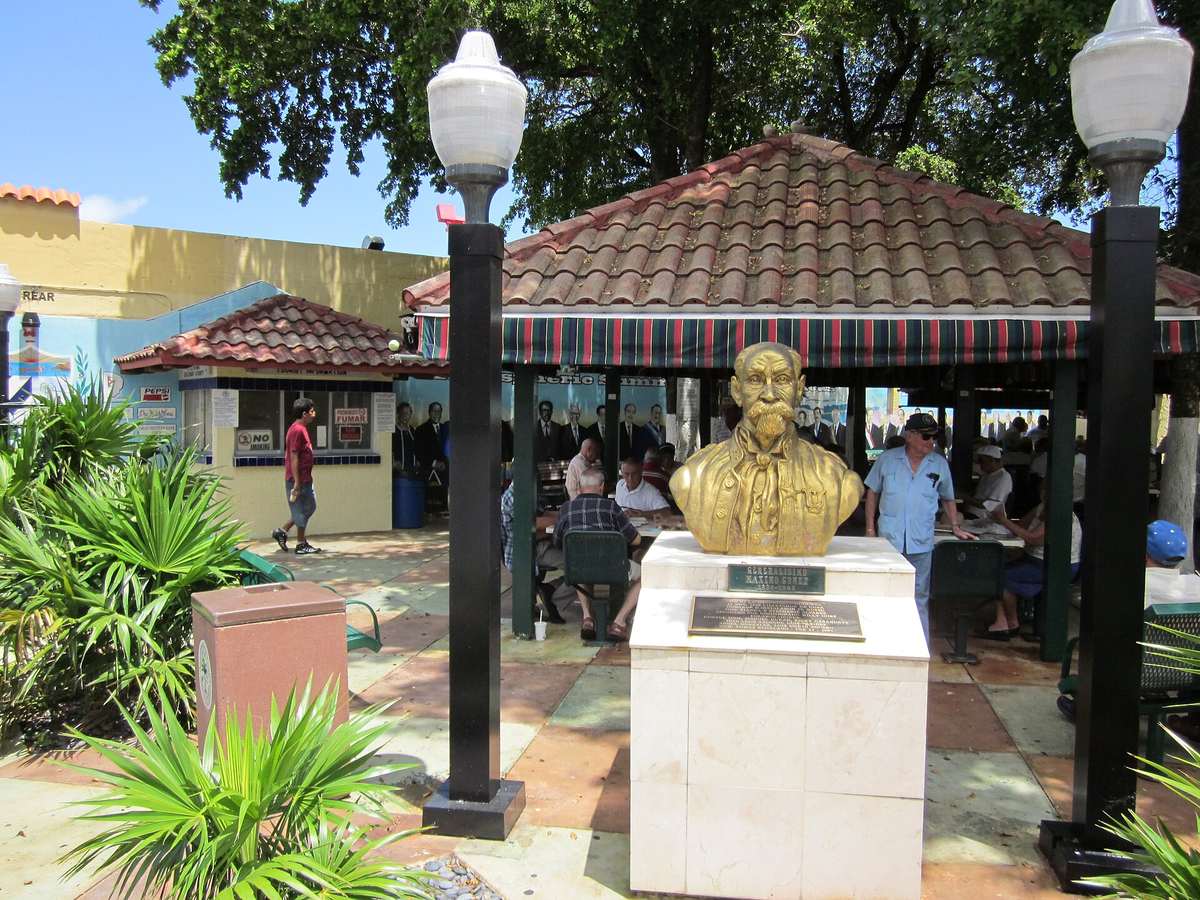
Little Havana is Miami's Cuban neighborhood, and its main street is Calle Ocho, SW 8th Street. Here you find Domino Park, a small city park with domino tables, the historic Tower Theater and a monument to the Cuban exiles of the Bay of Pigs. People come for the feel of Cuban Miami, and the free City of Miami Trolley runs here from Brickell.
Little Havana history: from suburb to Cuban neighborhood
Before the Cubans came, this was a quiet residential suburb. The National Trust for Historic Preservation notes that its buildings are still Mediterranean-style bungalows, courtyard apartments and small commercial buildings with corner stores.
The Cuban Revolution of 1959 changed it. Miami-Dade County says that in the 1960s thousands of refugees from Cuba began coming into the area. Historian Jeffrey Pilcher (University of Minnesota), writing for the National Park Service, says Cuban exiles turned it into Little Havana in the 1960s, centered on the cafes and street vendors of Calle Ocho.
Historian Lillian Guerra (University of Florida), also for the National Park Service, describes what the first refugees met. The exodus of the Cuban middle class peaked between 1965 and 1972. Miami was not always welcoming in the 1960s and early 1970s: rental signs reading "No Children, No Pets and No Cubans" became, in her words, a legendary example of hostility. Cubans stayed close in their own enclaves, Little Havana and Hialeah. Federal support came through the Cuban Refugee Program and the 1966 Cuban Adjustment Act.
Help also ran through the Freedom Tower. Miami Dade College, its steward since 2005, says the building served as the Cuban Assistance Center from 1962 through 1974, offering relief to Cuban refugees seeking asylum.
The marielitos arrived in 1980, and refugees from Central America came in the 1980s. Guerra writes that Miami's most Cuban areas are now shared with other Latinos, especially Central Americans, while Little Havana remains the symbolic heart of the exile story. The National Trust calls the neighborhood "Miami's Ellis Island" and named it to its list of America's 11 Most Endangered Historic Places in 2015, citing development pressure, demolition, displacement of residents and zoning changes. A 2019 revitalization plan drew input from more than 2,700 residents and stakeholders.
What to see in Little Havana
Calle Ocho (SW 8th Street)
The neighborhood's main commercial street. The National Trust calls it Miami's second most popular tourism destination. Its sidewalk, Guerra notes, carries a Hollywood-style walk of fame.
Domino Park
A small city park at 1444 SW 8th Street. The City of Miami lists domino and chess tables and bathrooms, and the park can be reserved. It is open daily from 9 am to 6 pm.
Tower Theater
The theater sits on Calle Ocho next to Domino Park. Miami Dade College says it opened in December 1926 with the silent romantic comedy "The Palm Beach Girl". In 1931 Wometco had architect Robert Law Weed redesign it in the Art Deco style. In the 1960s, as Cuban exiles settled in Little Havana, it began showing English-language films with Spanish subtitles and later Spanish-language films; the college says it was the first in the county to offer Spanish subtitles for English-language movies. The City turned it over to the college in 2002 and ended that arrangement in 2022. The college took over again on November 1, 2026, with its Miami Film Festival running the programming. In a release of October 29, 2026, the college said the theater remained temporarily closed for improvements and was expected to reopen to audiences in early 2027. Check towertheatermiami.com before a visit.
Bay of Pigs monument
Guerra mentions Little Havana's monument to the Cuban exile "martyrs" of the Bay of Pigs, whose inscription calls the operation an "assault".
Jose Marti Park
A city park at 362 SW 4th Street with a playground, sports areas, bathrooms, parking and waterfront access; leashed dogs are allowed. It is open daily from 6 am to 10 pm.
How to get to Little Havana
The easiest way is the free City of Miami Trolley. Its Little Havana route connects the neighborhood with Brickell. Stops the City names include:
| Stop | Why get off |
|---|---|
| Brickell Metrorail/Metromover Station | transfer to Metrorail and Metromover |
| Jose Marti Park / Domino Park | both parks |
| Miami Senior High School / Lincoln Marti Charter | schools |
| Magic City Casino | the casino |
The City says its trolleys arrive roughly every 15 to 45 minutes. Schedules for all routes and a link to the live trolley map are on the Miami Trolley page; the help line is 305-416-1132. The City of Miami trolley does not go to Miami Beach.
Miami-Dade Metrobus is the other option: $2.25, or $1.10 discounted. Bus-to-bus transfers within 3 hours and bus-to-rail transfers are free. Pay with an EASY Card, EASY Ticket, the GO Miami-Dade Transit app, a contactless card or cash. Plan a route on the Metrobus page.
Little Havana hours and tickets
Little Havana is an ordinary city neighborhood, with no hours or admission of its own. Individual places have hours:
| Place | Hours | Admission |
|---|---|---|
| Domino Park | daily 9 am - 6 pm | no fee listed on the City page |
| Jose Marti Park | daily 6 am - 10 pm | no fee listed on the City page |
| Miami Trolley, Little Havana route | Mon-Sat 6:30 am - 11 pm, Sun 8 am - 8 pm | free |
| Tower Theater | closed for improvements until early 2027, per the college's release of October 29, 2026 | check towertheatermiami.com |
Hours and prices checked on November 5, 2026 at miami.gov, miamidade.gov and news.mdc.edu.
Tips and recurring events
- Viernes Culturales (Cultural Fridays). An art, music and culture festival run since 2000 by the nonprofit Viernes Culturales/Cultural Fridays. Its site says it takes place on the last Friday of the month on Calle Ocho between 8th and 27th Avenues, with a free evening walking tour. Check viernesculturales.org for the schedule.
- Calle Ocho festival. A music festival within Carnaval Miami, which is powered by volunteers of the Kiwanis Club of Little Havana. Carnaval Miami benefits the Kiwanis of Little Havana Foundation's youth development programs. Dates are posted at carnavalmiami.com.
- Park questions. Call the City at 311 or 305-468-5900; Domino Park's own line is 305-859-2717.
For the rest of the city, see our Miami page and what to see in Miami. The Little Havana trolley can be boarded at Brickell Metrorail/Metromover Station.
Questions people ask
How much is the trolley to Little Havana?
Nothing. The City of Miami Trolley is free for everyone. The Little Havana route links the neighborhood with Brickell Metrorail/Metromover Station and stops at Jose Marti Park and Domino Park. It runs Monday to Saturday from 6:30 am to 11 pm and Sunday from 8 am to 8 pm; the City says trolleys arrive roughly every 15 to 45 minutes.
When is Domino Park on Calle Ocho open?
Domino Park, at 1444 SW 8th Street, is open every day from 9 am to 6 pm, according to the City of Miami. It has domino and chess tables and bathrooms. For questions, call the park at 305-859-2717 or the City information line at 311.
Is the Tower Theater open now?
Miami Dade College resumed managing the theater on November 1, 2026. In its release of October 29, 2026, the college said the theater remained temporarily closed for improvements and was expected to reopen in early 2027. Check the Tower Theater Miami site before a visit to see whether it is open. The theater opened in 1926 and stands next to Domino Park.
Why is it called Little Havana?
After the Cuban Revolution of 1959, Miami-Dade County says, thousands of Cuban refugees began arriving in the area in the 1960s. Historians writing for the National Park Service say Cuban exiles turned it into Little Havana, centered on Calle Ocho. Today immigrants from Central America live here too.
Places on the map
Sources
- City of Miami: Domino Park (address, hours, features)
- City of Miami: Jose Marti Park
- City of Miami: Trolley information, schedules and maps
- City of Miami: Trolley maps and routes (Little Havana route)
- Miami-Dade County: Metrobus fares and payment
- Miami-Dade County: About Miami-Dade County (history)
- National Park Service: American Latino Theme Study, New Latinos (Lillian Guerra)
- National Park Service: American Latino Theme Study, Food (Jeffrey M. Pilcher)
- National Trust for Historic Preservation: Little Havana
- MDC News: Miami Dade College resumes management and operation of Tower Theater Miami (Oct. 29, 2026)
- Miami Dade College: History (Tower Theater, Freedom Tower)
- Tower Theater Miami
- Viernes Culturales / Cultural Fridays
- Carnaval Miami (Kiwanis Club of Little Havana)