RussiansInUSA editorial team · Facts checked November 5, 2026 · Official site
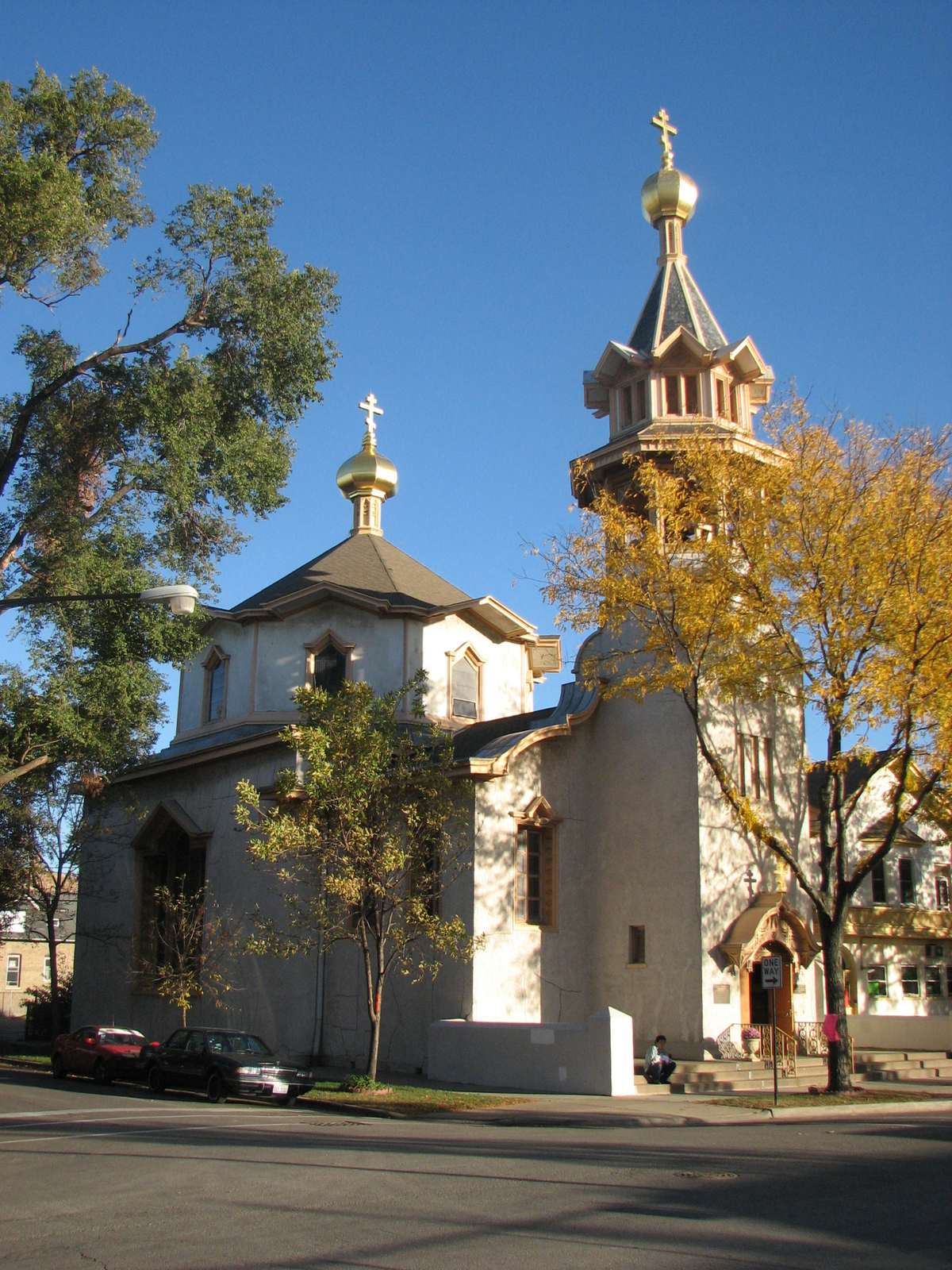
Holy Trinity Orthodox Cathedral stands at 1121 North Leavitt Street in Chicago's Ukrainian Village. Louis Sullivan, one of the most influential American architects, designed it, and today it is the cathedral of the Diocese of Chicago and the Midwest of the Orthodox Church in America. Come for a small stucco church modeled on Russian provincial churches, and for a neighborhood where Ukrainian churches stand a few blocks away. The Chicago city page mentions it briefly; this page goes further.
History of Holy Trinity Cathedral: Sullivan, Kochurov and Tikhon
According to the cathedral, the community began in 1892 as St. Vladimir's, founded by a small group of Orthodox immigrants from Carpatho-Russia and Galicia. Its first services were held in a house on North Noble Street, then in a rented home on Armitage (then called Centre) near Racine.
The church was built by Father John Kochurov, born in Riazan in 1871, ordained in 1895 and sent as a missionary to America the same year. The parish asked Louis Henry Sullivan to design the church and its parish buildings. The cathedral writes that archival references point to a small wooden church in the Siberian village of Tatarskaya as the model for his final design. The Commission on Chicago Landmarks adds that the church was modeled on the Russian provincial churches its first parishioners knew, and that Tsar Nicholas II helped pay for it.
The cornerstone was laid on March 31, 1902. On March 29, 1903, the Fourth Sunday of Great Lent, Bishop Tikhon of the North American mission of the Russian Orthodox Church consecrated it. Father John returned to Russia in 1907 and was martyred in 1917; the Russian Orthodox Church canonized him in 1994, and the cathedral honors him as St. John of Chicago. Tikhon was elected Patriarch of Moscow and All of Russia in 1917.
Holy Trinity became a cathedral in 1922. It was listed on the National Register of Historic Places in 1976 and designated a Chicago Landmark on March 21, 1979. In 2021, donors paid to restore the metal trim around the roof and windows and the stucco of the church and rectory; where the old metal could not be saved, replica ornament went up, a method the landmarks commission approved.
Ukrainian Village: the neighborhood and its churches
The city's Ukrainian Village District, designated on December 4, 2002, covers blocks roughly bounded by Haddon, Damen, Rice and Western. The city says German, Polish and later Ukrainian immigrants settled here from the late 1800s into the early 1900s. Nearly one building in three was developed by William D. Kerfoot, the first real estate developer to reestablish his business after the Great Fire of 1871. The housing mixes workers' cottages, two- and three-flats, single-family homes and large apartment buildings.
St. Nicholas Ukrainian Catholic Cathedral is at 835 North Oakley Boulevard. Its parish writes that the first Ukrainian immigrants, from western and Carpathian Ukraine, reached Chicago in the late 1890s and called themselves Rusyns. On December 31, 1905, 51 of them met on Robey Street (now Damen Avenue) and founded the parish. They bought twenty lots on Rice Street between Oakley and Leavitt for $12,000, Bishop Soter Ortynsky blessed the cornerstone in 1913, and the first liturgy was served on Christmas Day, January 7, 1915. The church has 13 domes, for Christ and the twelve apostles. In 1961 the Holy See set up a Ukrainian eparchy in Chicago, with Jaroslaw Gabro as its first bishop.
When a bishop required all churches in the eparchy to follow the Gregorian calendar, a group of parishioners left and founded Sts. Volodymyr and Olha Church at Oakley and Superior, which keeps the Julian calendar. So the neighborhood holds churches of different traditions side by side: Orthodox Holy Trinity, of the Orthodox Church in America, and the Ukrainian Catholic St. Nicholas and the church that grew out of its parish.
What to see at the cathedral and nearby
From the street, look at the shape: load-bearing brick walls covered in stucco, the dome and the bell tower. The cathedral calls the metal trim along the roof and windows classic Louis Sullivan design. The landmarks commission points out the two-story rectory, whose roofline repeats the church's curve, and calls the whole project one of Sullivan's most inspired small-scale works.
The cathedral has a copy of the Tikhvin icon of the Mother of God, the cathedral's protectress. The original came here in 1949 and went back to Russia in 2004; the copy was presented in 2016. The cathedral also keeps the memory of St. John of Chicago, whose feast is October 31.
Afterward, walk a few blocks to Oakley Boulevard and Rice Street for the 13 domes of St. Nicholas, and look at the streets themselves: the cottages and flats are why the district is protected.
How to get there
By train: take the CTA Blue Line to Division. The line runs 24 hours between O'Hare and Forest Park; see the Blue Line page. The cathedral suggests taking the #70 Division bus west to Leavitt Street and walking one short block south. Westbound buses run about 5:20 a.m. to 11:20 p.m. on weekdays and from about 5:40 a.m. on weekends; exact times depend on the stop.
By car: from the Kennedy Expressway (I-90/94), exit at Division, drive west to Leavitt, turn left, go two short blocks past the cathedral to Thomas Street, turn left, then left into the first alley. Free parking in the lot behind the cathedral is available during its events; the cathedral asks drivers to approach westbound on Haddon from Damen or Hoyne.
Hours, tours and tickets
| What | How it works |
|---|---|
| Tours | Selected Saturdays, sign up on Eventbrite through the cathedral site |
| Private and group tours | By appointment, by email from the tours page |
| Tour languages | English, Russian, German |
| Price | Not stated on the site |
| Services | No fixed schedule on the site; see the parish calendar |
| Parking | Free, behind the cathedral, during events |
| Phone | 773-486-6064 |
Hours and prices checked on November 5, 2026 at holytrinitycathedral.net.
Holy Trinity is a working church, not a museum, so it has no set visiting hours. Saturday tours are not weekly: check the dates on the tours page, and find service times in the parish calendar linked from the contact page. Large groups are welcome with notice. More of the city is in what to see in Chicago.
Questions people ask
Is Holy Trinity Cathedral in Chicago Russian or Ukrainian?
It is a cathedral of the Orthodox Church in America, the seat of its Diocese of Chicago and the Midwest. Immigrants from Carpatho-Russia and Galicia founded the community in 1892, Father John Kochurov from Riazan built the church, and Bishop Tikhon of the Russian Orthodox Church consecrated it. St. Nicholas Ukrainian Catholic Cathedral is a separate church a few blocks away on Oakley Boulevard.
Who designed Holy Trinity Cathedral?
Louis Henry Sullivan designed it, and Father John Kochurov led the building. The cornerstone was laid on March 31, 1902, and the church was consecrated on March 29, 1903. The Commission on Chicago Landmarks says Tsar Nicholas II helped pay for construction. The city designated the church and rectory a Chicago Landmark in 1979.
Can I take a tour in Russian?
Yes. The cathedral says its tours are given in English, Russian and German. Regular tours run on selected Saturdays with sign-up through Eventbrite, and private or group tours are arranged by email through the tours page. The site does not state a price, so ask when you book.
How do I get to Ukrainian Village without a car?
Take the CTA Blue Line, which runs 24 hours, to Division. From there the #70 Division bus goes west to Leavitt Street, and Holy Trinity Cathedral is one short block south of the stop. St. Nicholas Ukrainian Catholic Cathedral is a few blocks away at 835 North Oakley Boulevard.
Places on the map
Sources
- Holy Trinity Orthodox Cathedral, Chicago
- History, Holy Trinity Orthodox Cathedral
- Tours, Holy Trinity Orthodox Cathedral
- Directions, Holy Trinity Orthodox Cathedral
- Contact, Holy Trinity Orthodox Cathedral
- Restoration, Holy Trinity Orthodox Cathedral
- Holy Trinity Orthodox Cathedral and Rectory, Chicago Landmarks
- Ukrainian Village District, Chicago Landmarks
- Our History, St. Nicholas Ukrainian Catholic Cathedral
- Blue Line, CTA
- 70 Division bus, CTA
- Holy Trinity Russian Orthodox Cathedral and Rectory, National Register (NRIS 76000693), NPS NPGallery
- National Historic Landmarks by state, NPS