RussiansInUSA editorial team · Facts checked November 5, 2026 · Official site
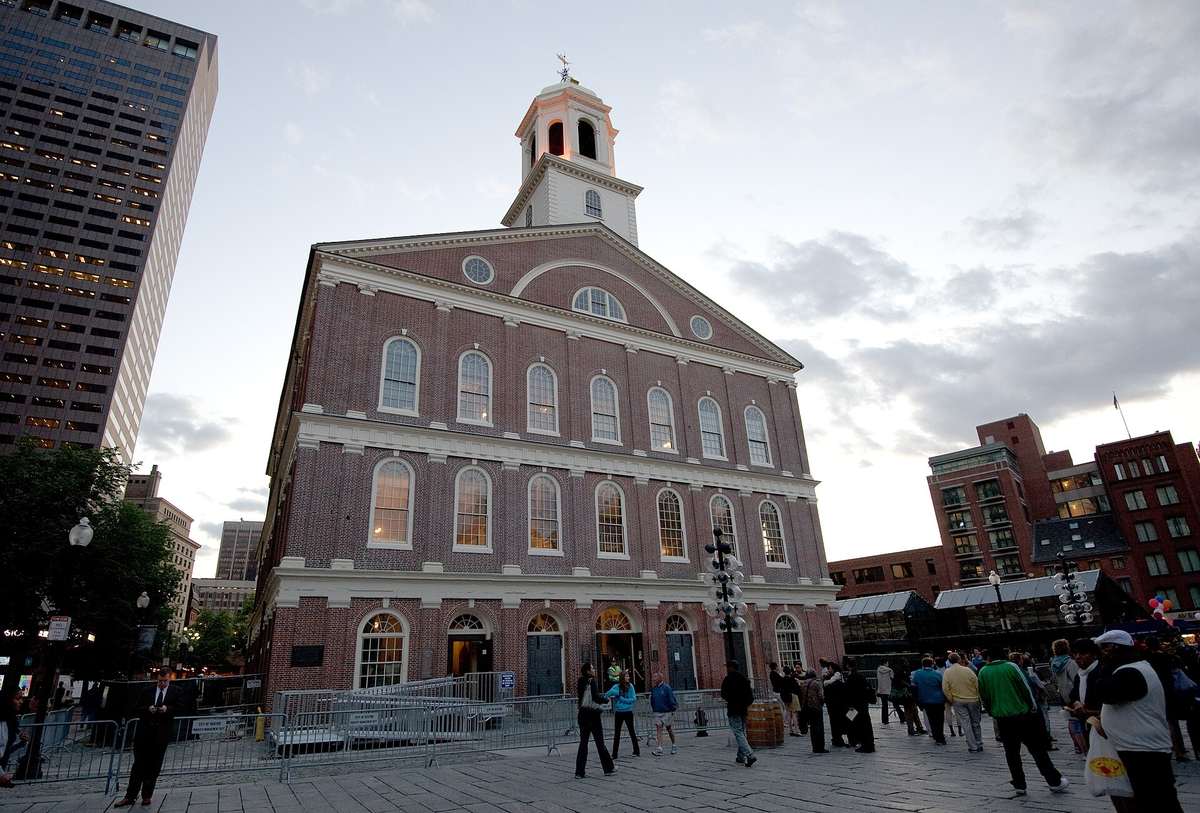
Faneuil Hall is a brick hall from 1742 in downtown Boston, at 1 Faneuil Hall Square, next to Quincy Market. It is known as the "Cradle of Liberty": town meetings met here, colonists protested British taxes here, and abolitionists and suffragists spoke here. Today it holds a free visitor center of Boston National Historical Park, and on the second floor the Great Hall, where rangers tell its story. Admission is free on all floors. NPS lists the hall as a National Historic Landmark.
Faneuil Hall history: a market that became the Cradle of Liberty
The hall was paid for by Peter Faneuil, a wealthy Boston merchant. The National Park Service (NPS) says his parents were French Huguenots who settled in New York in the early 1700s; Peter moved to Boston to live with his uncle Andrew Faneuil and inherited most of his business. He ran a trade empire across the Atlantic. NPS is plain about where much of that money came from: Faneuil owned enslaved people, traded in goods made by enslaved labor, and funded several voyages to buy enslaved Africans off the coast of Sierra Leone.
Faneuil offered the town meeting a permanent central market, and to win support he added a meeting hall above the market floor for the town government. It was finished in 1742, and the town named it for him. Trade went on downstairs; upstairs residents met, argued and voted, and the hall also held concerts, banquets and civic ceremonies. The grasshopper weathervane on the roof, NPS says in its virtual tour, was made of sheet copper by Shem Drowne in 1742.
A fire gutted the interior in 1761. The hall reopened in 1763, just as King and Parliament began taxing the colonies. In this room Samuel Adams, John Hancock, James Otis and others attacked the Sugar and Stamp Acts and called the first meetings that led to the Boston Tea Party. That is where the nickname comes from; NPS cites an early use in a Boston newspaper in 1797.
As Boston grew, architect Charles Bulfinch enlarged the hall to its current footprint, and it reopened in 1806. In 1822 Boston became a city with a mayor and aldermen, and town meetings ended, but the city kept the building as a place for public debate.
Abolitionists William Lloyd Garrison and Frederick Douglass spoke here again and again, and so did their opponents, Jefferson Davis among them. In 1873 Lucy Stone and other suffragists held the New England Woman's Tea Party in the hall. Labor activists, civil rights groups and, from the 1970s, the Gay and Lesbian Town Meetings followed. John F. Kennedy gave his final campaign speech before the 1960 election here.
The City of Boston still owns the hall, and NPS runs it as a visitor center and historic site. Rallies, civic events and naturalization ceremonies still take place in the Great Hall. According to the marketplace's own site, Quincy Market was added next door in 1826, named for Mayor Josiah Quincy, with the South Market and North Market buildings finished in 1827. By the mid-1900s the buildings stood mostly empty and were slated for demolition. In 1976 developer Jim Rouse, architect Benjamin Thompson and Mayor Kevin White reopened the district as a "festival marketplace."
What to see at Faneuil Hall
- The Great Hall, second floor. The old town meeting room. NPS rangers give free talks here, about 15 minutes each, on the building and the Bostonians who met in it. The hall closes at times for City events, and then there are no talks.
- NPS visitor center, market (first) floor and lower level. Information desk, maps and a Passport to Your National Parks stamp. The Find Your Park space on the lower level has regular films, activities and programs.
- Ancient and Honorable Artillery Company, fourth floor. The company occupies the fourth floor. Its museum and meeting hall are run separately from NPS and are generally open weekdays, 9 am to 3 pm.
- Ranger programs. Besides the talks, rangers recreate historic town meetings and lead the "Enemies to this Country" tour about the months before the War for Independence. Seasonal ranger tours of the Freedom Trail start here.
- The marketplace around it. The marketplace's own site calls Quincy Market and the buildings beside it a mixed use festival marketplace, with over 80 businesses and street performers and musicians.
Faneuil Hall is a stop on the Freedom Trail, the walking route through Boston's historic sites, which has its own page among our Boston places to see.
How to get to Faneuil Hall
There is no parking at or around the hall, and NPS strongly recommends public transit. Nearest MBTA subway stations:
| Station | Lines | Walk |
|---|---|---|
| State | Orange, Blue | exit onto State Street, half a block north on Congress Street |
| Haymarket | Green, Orange | exit onto Congress Street, about a block south |
| Government Center | Green, Blue | a short walk, per the marketplace's site |
From South Station or Back Bay, NPS suggests riding to State with a change to the Orange Line; from North Station, the Orange Line to State or the Green Line to Haymarket. For buses, use the MBTA trip planner. All three stations have elevators, and their status is on each station's page on mbta.com.
If you drive anyway, NPS suggests 60 State Street for your GPS, near several downtown parking options. The park does not validate parking. Many subway stations have lots for about $2 to $15 a day.
Faneuil Hall hours and tickets
| What | Open | Price |
|---|---|---|
| NPS visitor center | November 1-December 31, 2026: Wednesday-Sunday 10 am-5 pm, closed Monday and Tuesday | Free |
| Great Hall | November 1-December 31, 2026: Wednesday-Sunday 10 am-4:30 pm, closed Monday and Tuesday | Free |
| Ranger talks in the Great Hall | Year-round when the hall is open: Wednesday-Sunday at 10:30, 11:30, 12:30, 1:30, 2:30 and 3:30 | Free |
| Artillery Company museum | Generally weekdays 9 am-3 pm | Ask the company |
| Marketplace | Monday-Saturday 10 am-9 pm, Sunday 11 am-7 pm | Free to walk in |
Hours and prices checked on November 5, 2026 at nps.gov and faneuilhallmarketplace.com.
The table shows the NPS hours for November and December 2026. NPS says most park sites are open year-round but operating hours vary with the seasons and may change for maintenance or weather, and the Great Hall closes for City events. Check the Faneuil Hall page on nps.gov or the park's operating hours page before you go, or call the visitor center at 617-429-6760. Marketplace restaurant, retail and holiday hours may vary.
Tips before you go
To reach the Great Hall, enter through the main central doors across from Quincy Market or take the elevator from the market floor. The ramp and elevator are on the south side of the building. Talks start on the half hour, from 10:30 to 3:30.
A public event at Faneuil Hall needs a permit from the City's Property Management office. Apply at least 30 days ahead with a copy of your insurance certificate, through the City's event page on boston.gov.
More of the city is on our Boston page.
Questions people ask
Do you need tickets for Faneuil Hall?
No. Admission is free on all floors of Faneuil Hall, including the National Park Service visitor center and the Great Hall on the second floor. The 15-minute ranger talks in the Great Hall are free too. The Ancient and Honorable Artillery Company museum on the fourth floor is run separately and is generally open weekdays, 9 am to 3 pm.
Why is Faneuil Hall called the Cradle of Liberty?
In the 1760s Samuel Adams, John Hancock, James Otis and others spoke in its hall against British taxes such as the Sugar Act and the Stamp Act, and called the first meetings that led to the Boston Tea Party. For that role in the early American Revolution, the building became known as the Cradle of Liberty.
Is Faneuil Hall the same as Quincy Market?
No. Faneuil Hall was built in 1742 as a market and town meeting hall, and today holds the NPS visitor center and the Great Hall. Quincy Market, across from it, was built in 1826 and named for Mayor Josiah Quincy. With the North Market and South Market buildings it forms Faneuil Hall Marketplace, which its site calls a festival marketplace.
What is the closest T station to Faneuil Hall?
The National Park Service points to State station on the Orange and Blue Lines: exit onto State Street and walk half a block north on Congress Street. Haymarket on the Green and Orange Lines and Government Center on the Green and Blue Lines are also close. There is no parking at the hall itself.
Places on the map
Sources
- NPS, Boston National Historical Park: Faneuil Hall (hours, admission, ranger talks, accessibility)
- NPS: Faneuil Hall, "The Cradle of Liberty"
- NPS: Faneuil Hall (National Historic Landmark)
- NPS: Faneuil Hall virtual tour (grasshopper weathervane)
- NPS, Boston National Historical Park: directions
- NPS, Boston National Historical Park: operating hours
- City of Boston: how to hold an event near City Hall
- Faneuil Hall Marketplace: about (hours, businesses)
- Faneuil Hall Marketplace: history
- MBTA: State station
- MBTA: Haymarket station
- MBTA: Government Center station