RussiansInUSA editorial team · Facts checked November 5, 2026 · Official site
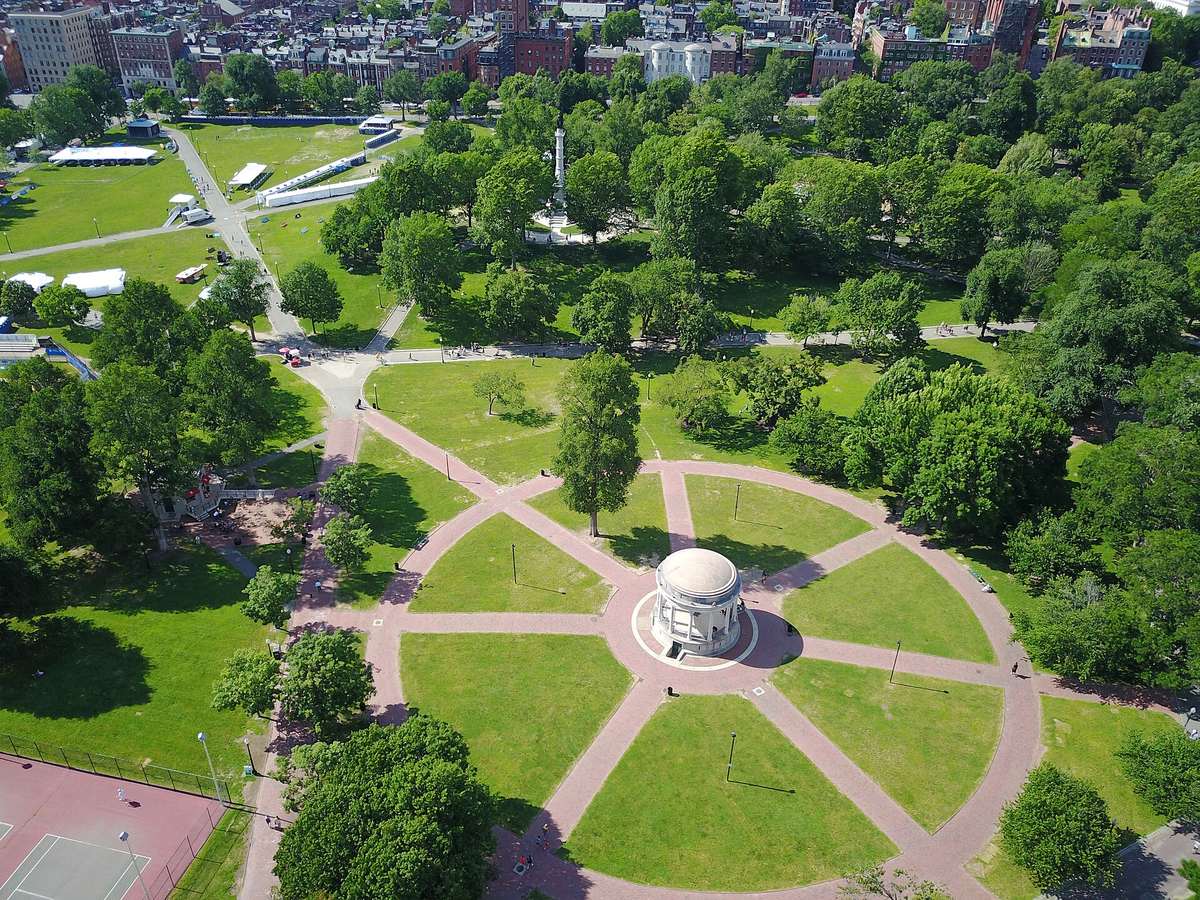
Boston Common is the city park in the heart of downtown Boston, at 139 Tremont Street, a five-sided park bounded by Tremont Street, Park Street, Beacon Street, Charles Street and Boylston Street. The City of Boston calls it America's oldest park: the land has been held in common since 1634. Entry is free all year. People come for colonial and Revolutionary history, 19th-century monuments, the Frog Pond, or as the starting point of a downtown walk.
Boston Common history
In 1634 Boston residents voted to tax households to buy William Blackstone's farm as a shared common. According to the Friends of the Public Garden, the city's nonprofit partner, each householder paid at least six shillings for roughly 50 acres. A 1640 order barred granting any part of the Common for private use, and the 1822 City Charter confirmed it.
In colonial times a village herd of about seventy milk cows grazed here under a town-appointed keeper. Militia trained on the Common, and it was a place of hangings, including of religious dissenters, especially Quakers.
From 1768 the British army camped here for eight years. The National Park Service says about 1,700 soldiers were entrenched on the Common in the winter of 1775-1776. British forces marched from here to Lexington and Concord, and later to Bunker Hill. Bostonians reclaimed the Common after the British evacuation in March 1776, and lit a large bonfire here in October 1781 for the surrender at Yorktown.
By 1830 the city had banished the cows, filled several ponds and laid out tree-lined malls; an iron fence went up in 1836. The Civil War brought recruitment rallies and anti-slavery protests. America's first subway tunnel, the Tremont Street Subway, runs under the malls: the MBTA says it opened in 1897 and still connects Government Center, Park Street and Boylston stations (the National Park Service dates the first US subway to 1895). Both world wars brought victory gardens, and most of the iron fencing went for scrap in World War II. Later came civil rights and anti-Vietnam War rallies, including one led by Martin Luther King, Jr. In 1979 Pope John Paul II celebrated Mass here, which the Friends call the first papal Mass in North America.
By the 1970s the park had lost half its trees and its fountains were dry. The Friends of the Public Garden, first gathered in 1970, took up its care, working with the Parks Department. The Common joined the National Register of Historic Places in 1972 and became a National Historic Landmark on February 27, 1987. It is a Freedom Trail site and one of the nine parks of the Emerald Necklace.
What to see on Boston Common
- Shaw/54th Regiment Memorial, opposite the State House on Beacon Street. Augustus Saint-Gaudens's bronze relief honors Colonel Robert Gould Shaw and the Massachusetts 54th, which the NPS calls one of the first Black regiments of the Civil War. He worked on it for nearly fourteen years, and it was unveiled on May 31, 1897. Shaw and many of his men died at Fort Wagner in July 1863.
- Soldiers and Sailors Monument, Flagstaff Hill. Martin Milmore's Civil War victory column, dedicated in 1877. The Friends say the hill and the Frog Pond are the only original features still discernible.
- Brewer Fountain, near the Tremont Street Mall. The Common's first public art, from 1868: a bronze cast of a French fountain that won a gold medal at the 1855 Paris World's Fair, with Neptune, Amphitrite, Acis and Galatea.
- Parkman Bandstand. A Greek temple form dedicated in 1912 to George Francis Parkman, who left $5 million for the Common and other city parks.
- Frog Pond. The last of the Common's three original ponds. Its fountain first ran in October 1848, at the celebration of the city's new water system. Skating on refrigerated ice in winter, a spray pool in summer, a reflecting pool in spring and fall. Nearby are a carousel, the Tadpole Playground (2002) and a year-round cafe.
- The Embrace, near the Parkman Bandstand. A memorial to Martin Luther King Jr. and Coretta Scott King, unveiled on January 13, 2023.
- Other memorials. The Boston Massacre Memorial near the Tremont Street Mall (1888) and the Founders Memorial on the Beacon Street Mall (1930, for Boston's 300th anniversary).
Across Charles Street is the Public Garden with its Swan Boats, a separate park with its own page in our Boston places section.
How to get to Boston Common
| Station | Where | Lines |
|---|---|---|
| Park Street | Tremont St and Winter St, east edge of the park | Red Line, Green Line (B, C, D, E) |
| Boylston | Boylston St and Tremont St, south corner | Green Line (B, C, D, E) |
| Government Center | northeast of the park | Blue Line, then transfer to the Green Line |
Park Street has elevators; mbta.com says Boylston is not accessible, with no elevators or escalators. The Green Line is sometimes closed for work and replaced by shuttle buses, so check alerts on mbta.com before you go.
By car, the Boston Common Garage at Zero Charles Street is the most convenient, with its entrance between the Common and the Public Garden; automated information line 617-954-2098. Street parking nearby is metered, two hours at most.
Hours and tickets
| What | Hours and price |
|---|---|
| Boston Common | free, all year; city rules bar being in the park from 11:30 pm to 6:00 am, except to walk through |
| Frog Pond | skating in winter; spray pool and carousel in spring, summer and fall; schedule at bostonfrogpond.com |
Hours and prices checked on November 5, 2026 at boston.gov and friendsofthepublicgarden.org.
The Friends of the Public Garden list the parks as open 6:30 am to 11:00 pm, with pedestrian access 24 hours a day. The Frog Pond is run by The Skating Club of Boston in partnership with the city; season dates and the rink schedule vary by year, so check the Frog Pond site, bostonfrogpond.com, before you go.
Park rules
From the Boston Parks and Recreation rules:
- No alcohol; on the Common, being under the influence is banned too.
- Dogs on a leash no longer than eight feet. The Friends say the only off-leash areas are on the Common, run by Common Canine.
- Bikes, scooters and skateboards only where permitted.
- No fires. Trash goes in receptacles.
- Amplified sound, vending and demonstrations need a city permit.
- No one over twelve may wade in the Frog Pond, and no speeches or leaflets within 25 feet of it.
The full rules are on boston.gov. More sights are on our Boston places page, and the city is covered in the Boston city guide.
Questions people ask
Does it cost anything to visit Boston Common?
No. Boston Common is free and open all year. The Frog Pond runs separately: skating in winter, and a spray pool and carousel in spring, summer and fall. The Skating Club of Boston operates it with the city and posts each season's schedule on bostonfrogpond.com.
Which T station is closest to Boston Common?
Park Street, at Tremont and Winter Streets, is served by the Red Line and all Green Line branches and has elevators. Boylston, at Boylston and Tremont Streets, is on the Green Line too, but mbta.com says it has no elevators or escalators and is not accessible.
Can I bring my dog to Boston Common?
Yes, on a leash no longer than eight feet, under Boston Parks and Recreation rules. The Friends say the only off-leash areas are on the Common itself, run by the group Common Canine. In the neighboring Public Garden, dogs must always stay on a leash.
Why is Boston Common called America's oldest park?
In 1634 Boston residents bought William Blackstone's farm as a shared common, and the land has stayed public since; a 1640 order barred granting any of it for private use. The National Park Service calls it the oldest public park in the United States, and it has been a National Historic Landmark since 1987.
Places on the map
Sources
- City of Boston: Boston Common
- City of Boston: Parks rules and regulations
- Friends of the Public Garden: The Common
- Friends of the Public Garden: Frog Pond
- Friends of the Public Garden: Hours and directions
- Friends of the Public Garden: Park policies
- National Park Service: Boston Common
- Boston Common Frog Pond (The Skating Club of Boston)
- MBTA: Park Street station
- MBTA: Boylston station
- National Park Service: Robert Gould Shaw and the 54th Regiment
- MBTA: The History of the T
- Friends of the Public Garden: Who we are